


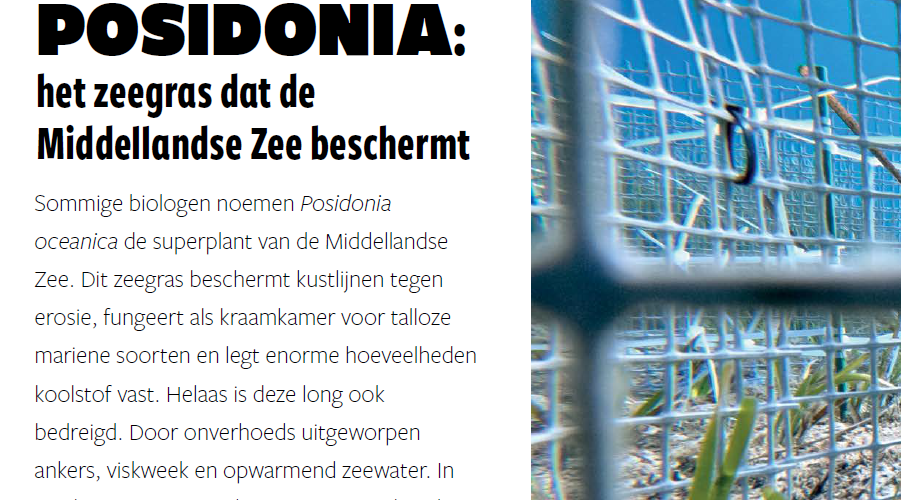
The Interreg Euro-MED ARTEMIS project was recently featured in an extensive article by science journalist Tom Peeters in the Belgian science magazine Eos Wetenschap.
The article, titled “Posidonia: The Seagrass That Protects the Mediterranean Sea”, explores the ecological importance of Posidonia oceanica meadows, their role in biodiversity conservation, coastal protection and carbon sequestration, as well as the threats they face from anchoring, fish farming and climate change.
As part of the feature, representatives of ARTEMIS partners shared insights on ongoing efforts to protect and restore these vital marine ecosystems in Greece. Dimitra Syrou from The Green Tank highlighted the policy challenges and opportunities related to the conservation and restoration of Posidonia, while researcher Vassilis Gerakaris from the Seagrass Ecology Laboratory of the Institute of Oceanography at the Hellenic Centre for Marine Research (HCMR) presented the organisation’s work on seagrass restoration and strengthening ecosystem resilience in the face of climate change.
The article also highlights the restoration actions being implemented in Atzikiari Bay, near Sitia in Crete, as part of the ARTEMIS project, emphasizing the importance of removing existing pressures as a prerequisite for successful ecosystem restoration.
In addition, Tasos Rodis from Katheti discussed the pressures faced by Posidonia meadows due to the expansion of fish farming in the Poros area, where the organization is active.
Read the translated English version of the article in Eos magazine below:
The Hidden Forests of Greece
POSIDONIA:
The Seagrass That Protects the Mediterranean Sea
Some biologists call Posidonia oceanica the superplant of the Mediterranean Sea. This seagrass protects coastlines from erosion, serves as a nursery for countless marine species, and stores enormous amounts of carbon. Unfortunately, this “lung” of the sea is also under threat—from carelessly dropped anchors, fish farming, and warming seawater. In Greek waters, efforts are underway to reverse the tide.
As the sun slowly sinks behind the islands of the Saronic Gulf, the marble columns of the Temple of Poseidon at Cape Sounion glow golden yellow. The sunset from these cliffs, 65 kilometers south of Athens, is one of the most photographed in Greece. Even today, tourists jostle for the best view.
In this country, hardly a rock, plant, or bend in the road exists without a myth attached to it, and the story of Cape Sounion is one every schoolchild knows. According to legend, King Aegeus waited here for his son Theseus, who had sailed to Crete to defeat the Minotaur. Theseus had promised to replace his black sails with white ones if he returned alive. When Aegeus saw black sails approaching in the distance, he threw himself from the cliffs in despair. Ever since, the water has borne his name: the Aegean Sea.
Later, the Greeks built a temple to Poseidon, god of the sea, atop these rocks. For sailors returning home, the marble was a reassuring sight: they were almost there.
Beneath the water’s surface grows a plant that bears the same god’s name: Posidonia oceanica. In the clear water, dark patches stand out against the emerald-green sea—vast meadows of long, ribbon-like leaves swaying gently with the currents. This is the hidden forest of the Mediterranean.
Labyrinth
Posidonia oceanica is not seaweed but a flowering plant. It has roots, stems, flowers, and in autumn produces fruits sometimes called “sea olives.” There are around sixty species of seagrass worldwide. Posidonia oceanica grows on sandy and rocky seabeds throughout the Mediterranean and spreads along the coast in dense underwater meadows.
“Depending on currents and waves, these meadows can sometimes form walls four meters high,” says marine biologist Vasilis Gerakaris of the Hellenic Centre for Marine Research. “When you swim through them, it feels like you’re in a labyrinth.” He recalls one of his first dives, when he saw a loggerhead turtle emerge around one such corner.
You can safely call Posidonia a superplant. It filters water and protects coastlines. Through its rhizomes and long leaves, it builds a strong three-dimensional structure on the seafloor—a natural reef that shields shores from erosion.
“The plants act as breakwaters,” says Gerakaris. “They minimize the energy with which waves reach the beach. If you lose Posidonia in front of your favorite beach, after a few years there won’t be much left of it.”
Posidonia also performs photosynthesis and produces large amounts of oxygen.
Gerakaris describes the plants as “biobuilders” and ecosystem engineers.
“From a barren environment—a sandy seabed where nothing grows—they create a habitat that supports more than a thousand species.”
The seagrass meadows are the forests of the sea, serving simultaneously as feeding grounds and shelter. They are nurseries for fish, seahorses, octopuses, rays, and turtles. Small fish, crustaceans, sea snails, and sea urchins hide among the leaves, forming the basis of a food chain that attracts larger species.
In the Mediterranean, it is difficult to find a plant or animal that does not depend on Posidonia in one way or another.
Even when dead, the plants remain valuable. In autumn, the leaves turn from dark green to brown and break off. Waves carry them to shore, where they accumulate on beaches. What some tourists see as untidy piles of debris is actually a natural barrier that keeps sand in place during winter storms.
Blue Carbon
Its importance extends even further.
Like terrestrial plants, Posidonia removes carbon dioxide from its surroundings and converts it into biomass. Through its rhizomes it builds a thick layer in the seabed—a compact structure of sediment, old roots, and organic material known as the matte. Carbon becomes trapped within this layer.
This is an example of “blue carbon”: CO₂ stored in coastal ecosystems such as mangroves, salt marshes, and seagrass meadows.
Blue carbon is a relatively new concept; the term was only coined in 2009. For a long time, few researchers examined how much carbon these ecosystems actually stored.
Seagrasses turn out to be remarkably efficient. Compared with trees and land plants, they absorb carbon more quickly—some studies suggest up to 35 times faster than tropical rainforests—and, more importantly, store it for longer periods.
On land, much of the stored carbon resides in tree trunks and branches. When trees die or burn, that carbon is released again. With Posidonia, most carbon is stored in the seabed beneath the plants. Left undisturbed, Posidonia can survive for extraordinarily long periods—sometimes hundreds of thousands of years—and the carbon can remain locked away for millennia.
Per hectare, seagrass meadows may therefore store more carbon than terrestrial forests. Some studies estimate that Posidonia meadows can capture up to fifteen times more carbon annually than an equivalent area of tropical rainforest, though estimates vary.
For Mediterranean countries, the plant could become an unexpected ally in the fight against climate change.
The Hellenic Centre for Marine Research calculated that Greece could achieve 37 percent of its greenhouse-gas sequestration target for 2030 simply by protecting existing Posidonia meadows rather than allowing further destruction.
“The potential is enormous, but it’s not black and white,” says Gerakaris. “A lot depends on the area, how large and old the meadows are, and how thick the sediment layer beneath them is. We still don’t know everything.”
Unfortunately, the reverse is also true: when seagrass meadows are destroyed, they release their stored carbon and become a source of emissions.
Death by a Thousand Cuts
Sixteen Doric columns of the Temple of Poseidon still stand at Cape Sounion. Lord Byron, deeply impressed by the site, once carved his name into the marble. He later wrote:
“Place me on Sunium’s marbled steep,
Where nothing save the waves and I
May hear our mutual murmurs sweep.”
Today the site remains a magnet for visitors.
During winter, tourists gather mainly on the cliffs. But when the days lengthen and the water warms, sailboats and motor yachts fill the bay. Some drop anchor to admire the temple from the sea.
A single anchor, carelessly dropped, can cut straight through a Posidonia meadow. Shoots are damaged, meadows become fragmented, and only a layer of dead rhizomes—a matte morte—remains behind.
In a few seconds, an anchor can destroy an ecosystem that took centuries to form. Posidonia grows agonizingly slowly. With every anchor, the damage increases—a death by a thousand cuts.
“Precisely because of the beauty and mythology of the place,” says Gerakaris, “Cape Sounion is one of the areas under the greatest pressure.”
Natural recovery can take hundreds of years.
Coastal development, pollution, and fishing also increase pressure on Posidonia. Wastewater and agricultural runoff release nutrients into the sea, making the water murkier and reducing the amount of light reaching the seabed. Desalination plants and industrial activities also disturb this fragile ecosystem.
Climate change adds further stress. Higher water temperatures do not immediately kill the plant, but they slow its growth and recovery.
Since the 1960s, the area covered by Posidonia in the Mediterranean has declined by between 13 and 50 percent. Some studies suggest that a warming climate could push Posidonia toward functional extinction by the middle of this century.
European legislation already protects Posidonia as a priority habitat. Yet laws on paper are not always enough.
“The main problem is implementation,” says policy expert Dimitra Syrou of The Green Tank, an environmental think tank in Athens. “Especially with anchor damage, it is almost impossible to determine who was responsible.”
Awareness is growing, however.
“Every Greek has at some point become tangled in it while walking on the beach,” says Syrou. “But only now are we beginning to appreciate its true value.”
Increasingly, people are discussing ways to assign financial value to the ecosystem services Posidonia provides.
“If we can put a price on those services—through carbon credits or a small contribution from tourists, for example—it could help finance protection and restoration.”
More Fish Than France
On the northern coast of Poros, an island connected to mainland Greece, Tasos Rodis carefully drives his four-wheel-drive vehicle along a rough track.
Suddenly the trees open to reveal a view of blue water dotted with dark rings.
“Those are fish cages,” he says.
Rodis heads Katheti, a local organization focused mainly on culture but also active in opposing the expansion of fish farming around Poros.
“According to the plan, they would have expanded by a factor of twenty-five,” he says. “More sea bream and sea bass would have been farmed here than in all of France.”
The proposal was part of a national strategy adopted in 2011 to dramatically expand aquaculture in Greece. Poros was designated one of the country’s strategic zones for large-scale fish farming.
Critics feared that up to a quarter of the island’s coastline would become occupied by industrial facilities.
Below the waterline grows Posidonia.
And that is precisely where the problem lies.
Fish farms can have a severe impact on seagrass meadows.
“Under the cages, the seabed is basically a dead zone,” says Rodis. “Everything that sinks down—feed, waste, dead fish—creates a layer where nothing can grow. The impact doesn’t stop at the cages. Sometimes the seagrass disappears hundreds of meters away.”
Researchers from the University of Oxford studied the effects of fish farming on Posidonia around Poros. They found damage extending almost a kilometer from the cages. In some areas, Posidonia cover had declined by nearly half, and the leaves were significantly shorter.
Even after a fish farm is removed, the ecosystem may require at least fourteen years to recover.
Scientists still debate the exact extent of fish-farming impacts because local conditions such as currents, water depth, and seabed shape vary widely. In some places, effects extend hundreds of meters; elsewhere, they are barely detectable.
Greek regulations prohibit fish farms directly above Posidonia meadows and require impacts to remain within fifty meters. Yet because seagrass was not systematically mapped for many years, some developments were approved without accounting for its presence.
In the summer of 2025, the Greek government ultimately rejected the Poros expansion plans.
Posidonia was only one of several arguments, but supporters hope the decision will serve as a precedent elsewhere in Greece.
Backup Plan
The EU Nature Restoration Law requires member states to restore damaged ecosystems: at least 20 percent by 2030, with increasingly ambitious targets through 2050.
For seagrass, that means active restoration of degraded meadows.
In Crete, one of four EU pilot projects under the Artemis program is exploring what restoration might look like in practice. Scientists from the Hellenic Centre for Marine Research cleaned up a bay polluted by fish farming and planted Posidonia shoots in experimental plots. Different techniques are being tested side by side.
Dimitra Syrou, whose organization participates in Artemis, emphasizes that active restoration should be a last resort.
“There is little point trying to restore tomorrow what is being destroyed today,” she says.
“We cannot plant Posidonia across the entire Mediterranean—it would be far too expensive. Often it is wiser to let nature do the work. But first we must remove the pressures. Posidonia often has the ability to recover on its own.”
The same principle applies in Sounion Bay, where Vasilis Gerakaris is conducting a unique experiment.
Two years ago, the seagrass meadows there flowered en masse—an exceptionally rare and unpredictable event.
Normally, seagrass reproduces vegetatively through rhizomes, like ordinary grass. Flowering and seed production require enormous energy and occur only occasionally.
“We think marine heat waves trigger flowering,” says Gerakaris. “Heat causes stress, prompting the plants to produce seeds with new genetic variation—a way of adapting to a warmer sea.”
Thousands of seeds washed ashore. Gerakaris received hundreds of emails from people who had found them. He collected as many as possible and brought them to the laboratory, where he exposed them to simulated heat waves—a kind of thermal training intended to prepare young plants for the sea of the future.
Eventually, five hundred resistant seedlings survived.
These were planted in Sounion Bay under different experimental conditions. Some were protected by cages that kept sea urchins and other herbivores away; others were left fully exposed. Anchoring methods and substrate types were also varied.
The first conclusions are expected only after a year.
Whether this approach—using seeds instead of transplanted plants—can be scaled up remains highly uncertain.
“You can’t rely on it because of how infrequently mass flowering occurs,” says Gerakaris.
Still, with warming seas and increasingly intense marine heat waves, he wants to be prepared whenever the opportunity arises.
“It’s a backup plan.”
Ancient Forests
At Cape Sounion, the sun disappears beyond the horizon. Tourists climb back into their buses.
Beneath the water’s surface, Posidonia continues growing patiently—at a rate of only about one centimeter per year.
A single clone can be tens of thousands of years old. In some documented cases, the seed from which a clone originated likely germinated on the seabed around 200,000 years ago.
That makes Posidonia one of the longest-living organisms on Earth.
Yet an anchor can destroy it in a second.
“Recovery takes a very, very long time,” says Dimitra Syrou. “That’s really the only disadvantage of Posidonia—it grows so slowly. You can invest in restoration today, but the benefits may only become visible decades later.”
That makes securing political and financial support more difficult. Politicians tend to think in electoral cycles, not centuries.
“Perhaps,” she suggests, “we should treat Posidonia meadows the way we treat ancient forests.”
The ancient Greeks built a temple for the god of the sea at Cape Sounion. Today, scientists are trying to save the ecosystem beneath it.
The temple still stands. The meadows are disappearing.
Perhaps Poseidon’s true legacy is not the marble columns above the sea, but what grows beneath it—something that existed for centuries before the first stone was laid, and that, if we do things right, will remain long after we are gone.


