


The Green Tank Newsletter #3 | July-September 2026
In this issue, we explore the challenges and choices shaping the transition to a sustainable future. From electricity prices, renewables and fossil gas to nature conservation, marine ecosystems and the future of lignite regions, we look at the developments shaping the energy transition and the path towards a fairer, more sustainable future.
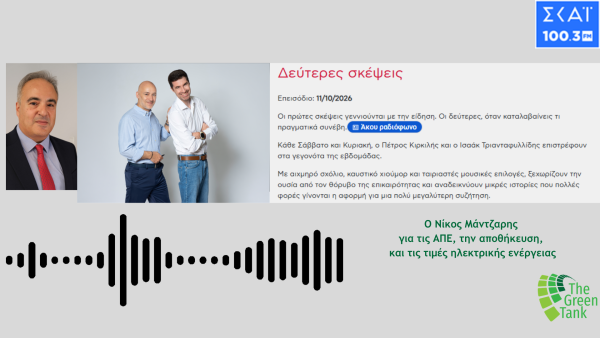
The Green Tank on SKAI Radio: The role of renewables and energy storage in electricity prices
Nikos Mantzaris, co-founder and Lead Policy Analyst at The Green Tank, spoke on SKAI Radio’s programme Defterες Skepseis on Sunday, 11 October 2026, with hosts Petros Kirkilis and Isaak Triantafyllidis. The discussion focused on electricity prices, the contribution of renewable energy sources (RES) and the need to accelerate energy storage deployment.
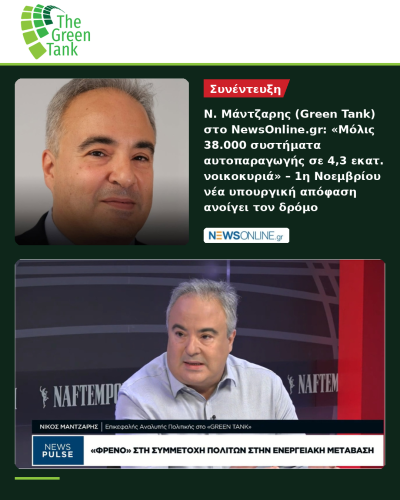
The Green Tank on Naftemporiki TV and NewsOnline: Self-generation can reduce energy costs, but urgent action is needed
The role of self-generation and Energy Communities in reducing energy costs, as well as the barriers that continue to hinder their development, was discussed by Nikos Mantzaris, Policy Analyst and co-founder of The Green Tank, in interviews with Naftemporiki TV and NewsOnline.
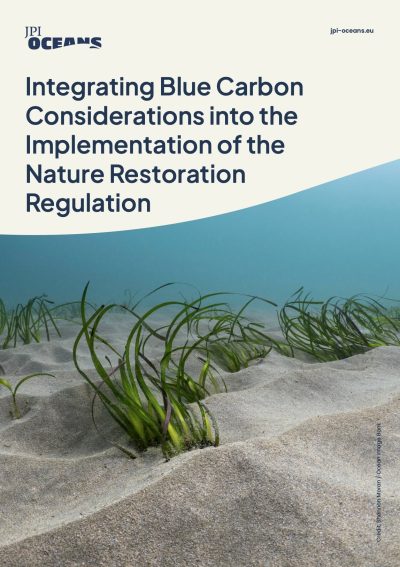
New policy brief on blue carbon and nature restoration
Integrating blue carbon ecosystems into National Nature Restoration Plans, improving their monitoring and strengthening policy coordination are key to ensuring their effective restoration. This is highlighted in a new policy brief by the JPI Oceans Blue Carbon Knowledge Hub, to which The Green Tank contributed.
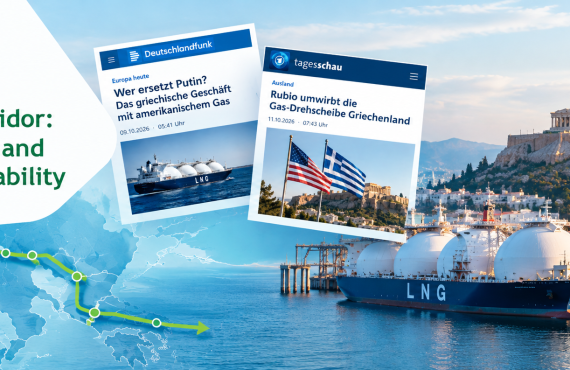
The Green Tank’s report on the Vertical Corridor featured in German media
Europe aims to end all Russian gas imports by November 2027. Greece aspires to play a central role in this effort, becoming a gateway for US liquefied natural gas (LNG) to Southeastern and Central Europe through the Vertical Corridor. But how much of this new infrastructure is actually needed, and what will it cost consumers? These questions were explored in two German media reports by Jasper Riemann featuring Nikos Mantzaris, Policy Analyst Lead and co-founder of The Green Tank.
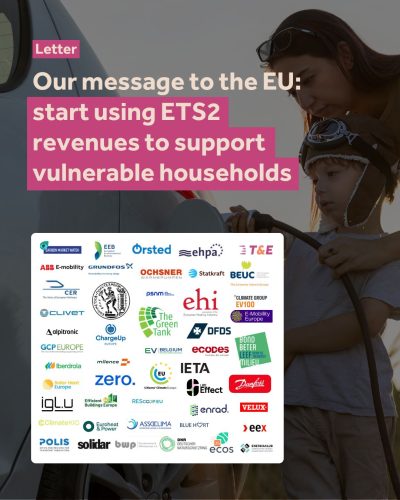
Joint letter calling for the implementation of ETS2 in 2028 without further delay
More than 50 companies, business associations and civil society organisations, including The Green Tank, have co-signed a joint letter calling on EU Member States to implement ETS2 in 2028, as agreed, without further delay. The Green Tank has signed the letter both as an organisation and as part of the LIFE Effect consortium.
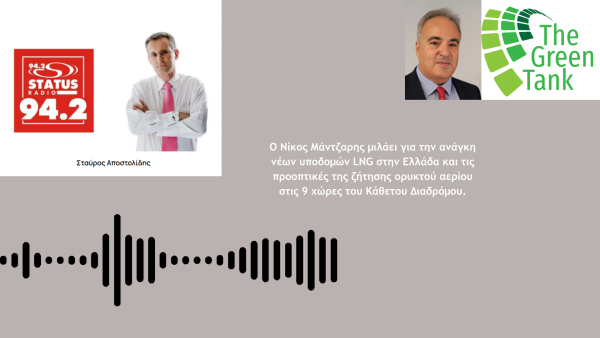
The Green Tank on Status Radio: Energy planning in Vertical Corridor countries does not justify new LNG infrastructure in Greece
Against the backdrop of the debate over the Vertical Corridor and US Secretary of State Marco Rubio’s visit to Athens, Nikos Mantzaris, Head of Policy Analysis and co-founder of The Green Tank, spoke to Stavros Apostolidis on Status Radio 94.2 on the need for new LNG infrastructure in Greece and the outlook for fossil gas demand in the nine countries of the Vertical Corridor.
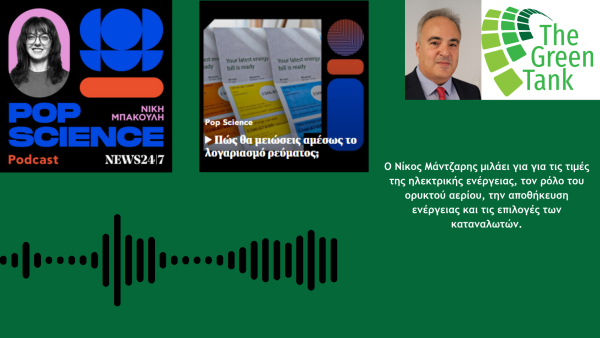
Nikos Mantzaris on News 24/7’s Pop Science
Why does electricity remain expensive despite the growing share of renewable energy? Nikos Mantzaris, Lead Policy Analyst and co-founder of The Green Tank, spoke with Niki Bakouli on Pop Science, News 24/7’s podcast about the factors shaping electricity prices and ways to reduce energy costs for consumers.

Trends in fossil gas consumption & imports – September 2026
Domestic gas consumption fell to a yearly low in September, at 4.35 TWh, due to the escalation of gas prices. However, over the first 9 months of the year, domestic consumption remained at high levels, ranking as the third-highest on record at nearly 50 TWh. Over the same period, LNG remained the leading source of imports, at 30.1 TWh, twice the volume of net imports through the Sidirokastro entry point. Exports reached 13.6 TWh in the first 9 months of the year, with the largest share (77.7%) being transported through the Sidirokastro exit point.
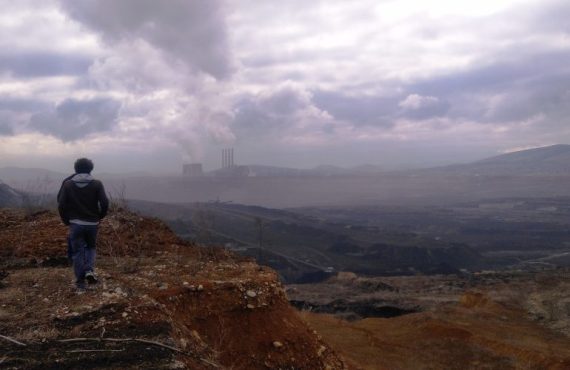
The Carbon Footprint of Electricity Production – August 2026
The upward trend in power sector emissions continued in August, reaching 1.38 million tonnes (+7.8% compared with July), driven by increased use of lignite and fossil gas, despite the record level of renewable energy generation recorded in the same month. With the addition of August’s emissions, cumulative sector emissions since the beginning of 2026 reached 9.6 million tonnes, exceeding the carbon budget set under the National Energy and Climate Plan (NECP) for the whole of 2026.
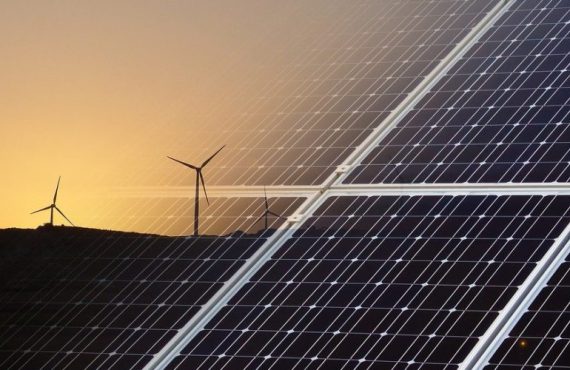
Trends in electricity production – August 2026
Renewables reached a new all-time monthly high in August, at 3,312 GWh. However, wholesale market prices hit a yearly high of €133.4/MWh, driven by increased gas usage, and higher gas prices rose in August due to the escalating crisis. Batteries prevented 15.4% of August’s RES curtailments, which were limited to 158.6 GWh for the month, but nevertheless approached 2 TWh (1,905 GWh) since the beginning of the year.
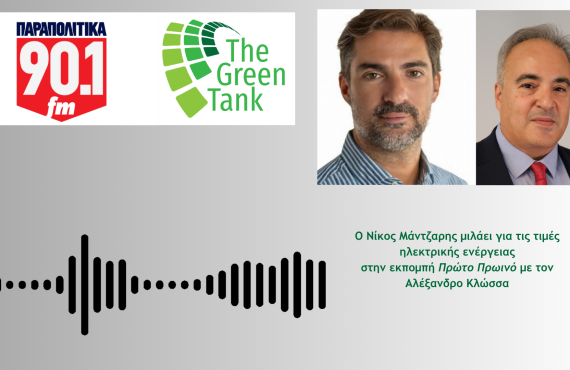
The Green Tank on Parapolitika FM: Cutting fossil gas use, accelerating batteries and expanding self-consumption to lower electricity prices
Nikos Mantzaris, Lead Policy Analyst and co-founder of The Green Tank, spoke to Alexandros Klossas on the “Proto Proino” morning show on Parapolitika FM 90.1 about the impact of geopolitical instability on energy markets, high electricity prices, and solutions that can help reduce costs for households and businesses.
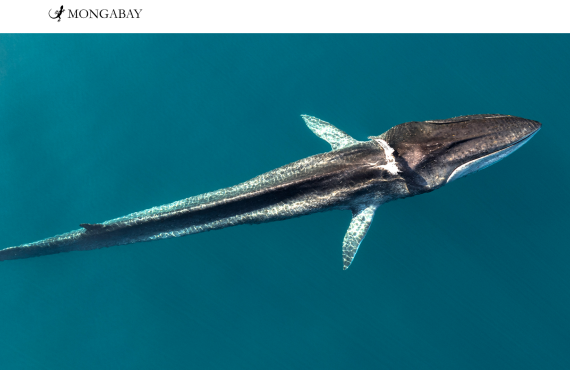
Can technology help protect Mediterranean whales from ship strikes?
Ship strikes are the leading human-induced threat to endangered sperm and fin whales in the Mediterranean. A special feature by Mongabay examines the scale of the threat, as well as the solutions being explored to address it. The feature highlights SAvE Whales, a project aimed at developing an innovative acoustic early-warning system for ships in the Strait of Kythira.
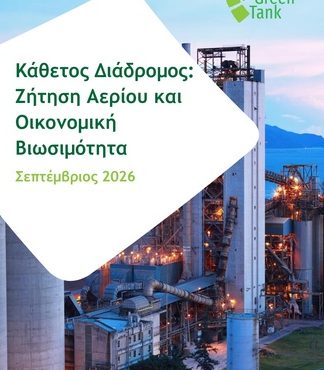
Vertical Corridor: Are New LNG Infrastructure Projects Really Needed?
A new analysis by The Green Tank, titled “Vertical Corridor: Gas Demand and Economic Viability,” examines whether existing and planned LNG infrastructure in Greece is needed to meet future fossil gas demand in the region through 2040. It also assesses the economic competitiveness of gas transit via the Vertical Corridor compared with routes from other entry points to Ukraine and Hungary.


