


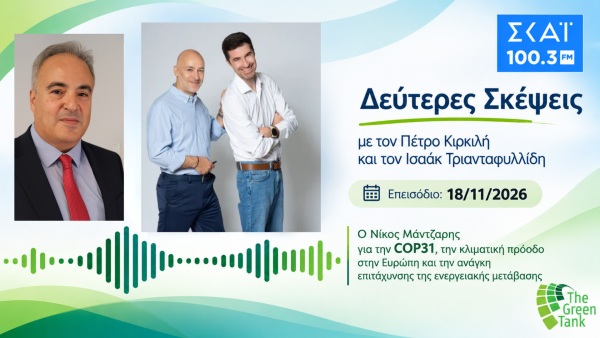
On 15 November 2026, Nikos Mantzaris, co-founder and Lead Policy Analyst at The Green Tank, joined Petros Kirkilis and Isaak Triantafyllidis on SKAI Radio’s “Deuteres Skepseis“ programme to discuss developments at the 31st UN Climate Change Conference (COP31), taking place in Antalya, Türkiye, the progress of Europe’s energy transition and the prospects for moving away from fossil fuels.
Despite a slowdown in climate action in recent years, Europe remains at the forefront of the transition, he noted. By 2025, the EU had cut its greenhouse gas emissions by 39% compared to 1990, while making significant progress in renewable energy deployment. Notably, the share of lignite in electricity generation fell from 25% to 9% in roughly a decade.
As Nikos Mantzaris stressed, the green transition has not failed. Rather, it needs to move faster, alongside the development of essential technologies such as energy storage. Delays in deploying storage capacity are exacerbating challenges in the energy system, while further renewable energy deployment, supported by the necessary infrastructure, is essential to reducing emissions.
The discussion also addressed the absence of the US federal government from COP31’s official negotiations. This has significant implications, both because of the United States’ substantial contribution to global emissions and because of the withdrawal of financial commitments to support developing countries. However, the presence of representatives from US state and local governments, as well as members of Congress, leaves room for different approaches in the future.
The competitiveness of European industry was another key topic. Businesses across Europe, including in Greece, are already investing in decarbonisation technologies, recognising that their long-term competitiveness depends on the transition to cleaner production processes. The challenge is to ensure that emissions reductions result not from a contraction in industrial production, but from its transformation.
Nikos Mantzaris concluded by emphasising that the progress already achieved demonstrates that the energy transition is possible. Resistance from fossil fuel interests and the challenges along the way should not lead to a retreat from climate targets, but rather to greater efforts to achieve them.
Listen to the full interview [in Greek] here.


