


New policy recommendations for restoring Posidonia meadows in Greece and across the Mediterranean
As EU Member States prepare their National Restoration Plans under the EU Nature Restoration Regulation and engage in negotiations on the priorities of the 2028–2034 Multiannual Financial Framework, a new report from the Interreg Euro-MED ARTEMIS project highlights what is needed to move from the legal protection of Posidonia meadows to the systematic implementation of restoration actions at national and Mediterranean scale.
What’s Really Driving Greece’s Electricity Exports to Bulgaria?
Recent commentary has suggested that Greece exports surplus renewable electricity to Bulgaria during the middle of the day, when solar PV output peaks and wholesale electricity prices are low, only for Bulgaria to store part of this electricity and sell it back to Greece at a higher price after sunset. While this narrative has gained…
From Ambition to Action: New Policy Recommendations for Restoring Mediterranean Seagrass Meadows
The restoration of Mediterranean seagrass meadows must move from fragmented pilot projects to long-term, large-scale action supported by coherent governance and sustainable financing, according to the new report released by the Interreg Euro-MED ARTEMIS project.

Citizen participation in the energy transition is losing momentum: Slowdown in energy communities and self-generation
Energy communities and self-generation are the main tools enabling citizens, local communities, and small businesses to actively participate in the energy transition. However, the latest data point to a continuing slowdown, both in the development of new projects and in the implementation of existing applications. The Green Tank’s 9th review of energy communities and self-generation in Greece analyses the latest available data from HEDNO, IPTO and GEMI, highlighting the most important trends.
Green Public Procurement: Key to Decarbonizing the Greek Cement Industry
The cement industry is one of the most carbon-intensive industrial sectors globally. Yet its decarbonization is accompanied by significant technical and economic challenges. With the window for achieving the EU’s binding 2030 climate targets rapidly narrowing and the gradual phase-out of free allowances under the EU Emissions Trading System (EU ETS) affecting the sector’s competitiveness, closing the investment gap for decarbonization projects has become an urgent priority.
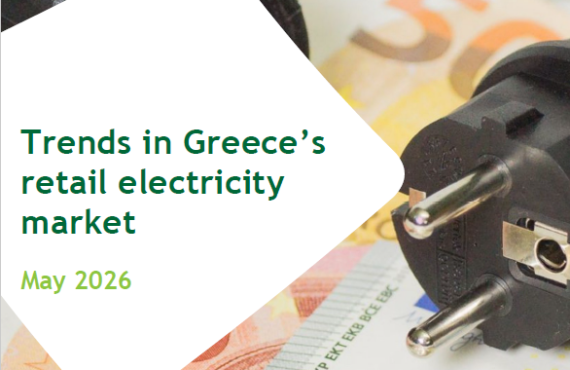
Retail electricity market: Greece among the most expensive in the EU – €1.23 billion in additional costs from green tariffs
In 2025, Greece had the highest retail electricity prices in the EU-27 in terms of consumers’ purchasing power and the third highest in nominal prices. At the same time, the more expensive green tariffs continued to dominate the market despite their high cost, while increased fossil gas use kept both wholesale and retail electricity prices at elevated levels.
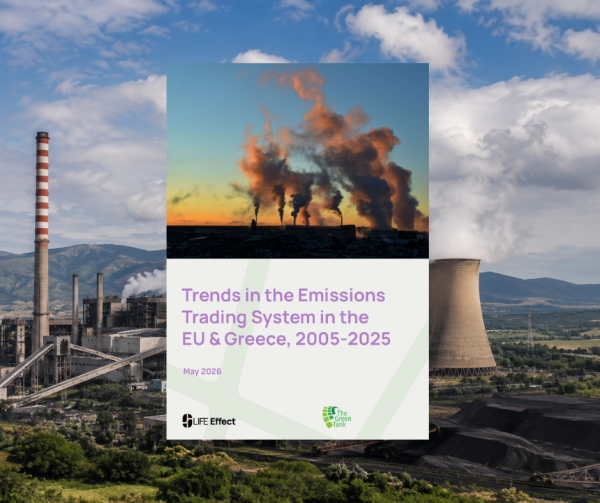
EU ETS 2025: Slowing progress and divergence from 2030 targets
Emissions from the four sectors covered by the EU Emissions Trading System (EU ETS) in the EU-27 remained largely unchanged in 2025 (-1.7%). At the same time, lignite and hard coal continued to account for 46% of emissions in the power and heat sector. In Greece, emissions from this sector increased due to higher fossil gas use, while the country recorded the highest maritime emissions in the EU. By contrast, the carbon footprint of the Greek cement industry fell by 9.2%, and that of refineries by 4.6%.
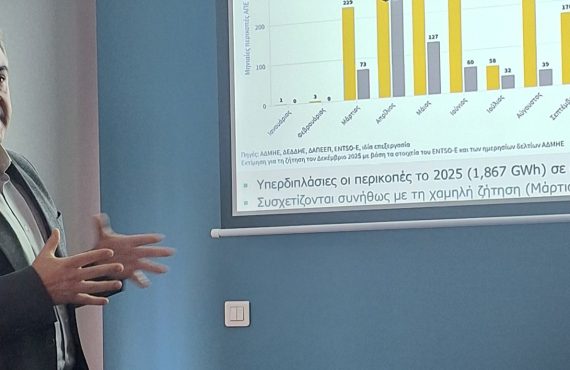
State of Climate in Greece 2025: The Electricity Generation Sector
As part of the State of Climate in Greece for 2025, conducted by scientists from the Institute for Environmental Research and Sustainable Development at the National Observatory of Athens and organized by the Climatebook information hub, Nikos Mantzaris presented the results of the Green Tank analysis for the electricity generation sector.
Stagnation in self-production and energy communities after the transition to net billing
1,747 energy communities, but only 18 new project applications in 6 months. Central Macedonia is the “champion” in electrified capacity, while in Western Macedonia for every 1 MW electrified, 3.6 MW are cancelled. The 1 GW “barrier” in self-generation was broken, however, from the ministerial decision on net billing (October 2024) to September 2025, only 16.5 MW of projects implementing the new mechanisms, were connected.
Why does Greece’s electricity market remain so expensive?
Despite the increase in electricity generation from Renewable Energy Sources (RES), Greece consistently remains among the most expensive countries in Europe in the day-ahead electricity market (DAM). According to a new analysis by The Green Tank, which also compares Greece with Portugal, the main reasons are the country’s growing dependence on fossil gas and the lack of energy storage infrastructure.

Greece ranks 6th in ETS emission reductions over 2005–2024
Despite notable progress, 2024 saw an increase in emissions from power generation in Greece due to fossil gas and stagnation in industrial emissions. In contrast, the EU-27 achieved a 20-year low in emissions in both sectors. Greece also ranked first among EU-27 countries in shipping emissions, while emissions from aviation doubled compared to 2013.

Social Equity in Protected Areas – The Green Tank Contributes to a Global Study
The Green Tank contributed to a major study assessing the governance of Protected and Conserved Areas (PCAs) worldwide. The study was led by a team from the International Institute for Environment and Development (IIED), with input from the Fidelio program and under the scientific guidance of Dr. Nicoletta Jones (Warwick University / University of Cambridge).

Greece and ETS2: What It Means for Households and How to Protect the Most Vulnerable
Spending by vulnerable households in Greece is expected to increase by up to EUR 1.6 billion between 2027 and 2032 due to the implementation of the new Emissions Trading System (ETS2) for buildings and road transport. A new study by The Green Tank and Facets recommends a mix of immediate and long-term measures, costing up to EUR 15.5 billion, leveraging the Social Climate Fund (SCF) and other available resources to protect vulnerable households while also contributing to climate targets.

Who pays for the cost of capacity mechanisms? The European example and Greece’s options
A new brief by The Green Tank analyzes the provisions of European legislation regarding capacity remuneration mechanisms (CRMs), outlines the technologies that other European countries are choosing to support via these mechanisms, and examines how these choices have so far affected consumers’ costs.


