


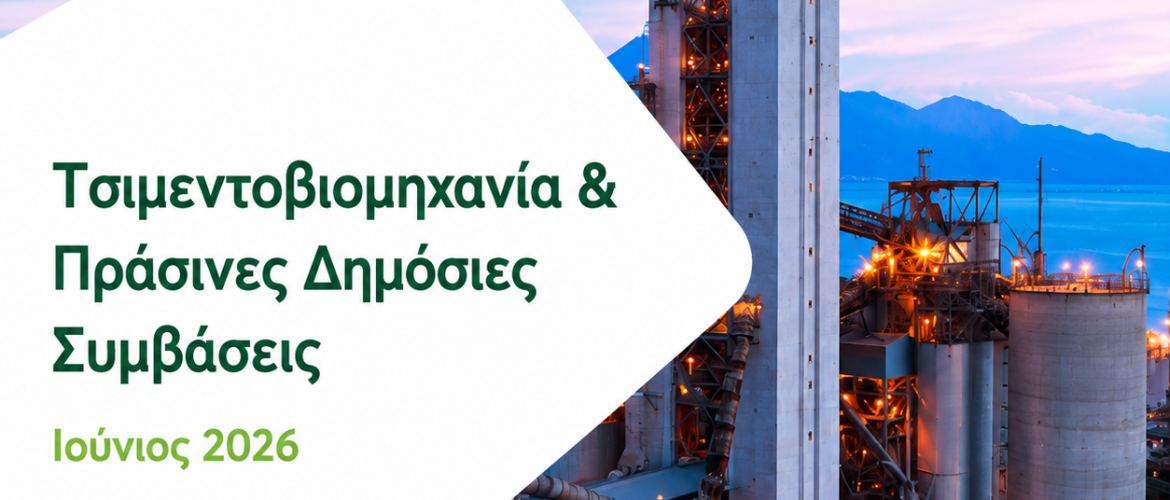
The cement industry is one of the most carbon-intensive industrial sectors globally. Yet its decarbonization is accompanied by significant technical and economic challenges. With the window for achieving the EU’s binding 2030 climate targets rapidly narrowing and the gradual phase-out of free allowances under the EU Emissions Trading System (EU ETS) affecting the sector’s competitiveness, closing the investment gap for decarbonization projects has become an urgent priority.
As Greece’s National Action Plan for Green Public Procurement (GPP) is currently under revision, The Green Tank’s new report, “Cement Industry & Green Public Procurement (GPP)”, highlights the pivotal role that Green Public Procurement can play in both decarbonizing and strengthening the competitiveness of the Greek cement industry.
The report first stresses that carbon capture and storage (CCS) technologies, although often presented as the primary solution for the sector, face significant technical and economic challenges, while relying heavily on public subsidies. For this reason, the report recommends limiting their use to process emissions that cannot be avoided through other means.
The remaining emissions can be reduced at source through the deployment of already mature solutions such as energy efficiency improvements, waste heat recovery, and the use of alternative fuels. At the same time, greater emphasis should be placed on less mature technologies, including clinker production electrification and the use of green hydrogen as an alternative fuel.
To help finance investments in these technologies, Green Public Procurement can play a catalytic role by creating stable and sufficient demand for low-carbon cement products.
In this context, the report puts forward the following policy recommendations:
- Develop a national certification framework for low-carbon cement products.
- Require Environmental Product Declarations (EPDs) in public procurement procedures for cement.
- Gradually introduce CO₂ emissions thresholds for cement products used in public projects.
- Provide financial incentives to cement producers investing in innovative decarbonization technologies.
- Increase resources for contracting authorities that lead the way in implementing Green Public Procurement.
- Join the international Industrial Deep Decarbonization Initiative (IDDI), strengthening Greece’s role in shaping international policies that support industry’s transition to climate neutrality.
“The decarbonization of the cement sector cannot rely exclusively on costly and complex carbon capture and storage technologies. The upcoming revision of Greece’s National Action Plan for Green Public Procurement presents a major opportunity to mobilize investments in both mature and emerging emissions-reduction solutions at source, while strengthening the competitiveness of the Greek cement industry,” said Stavros Gennitsaris, Industrial Policy Associate at The Green Tank.
Notes to editors:
- The full policy report, titled “Cement Industry & Green Public Procurement”, is available here.


