


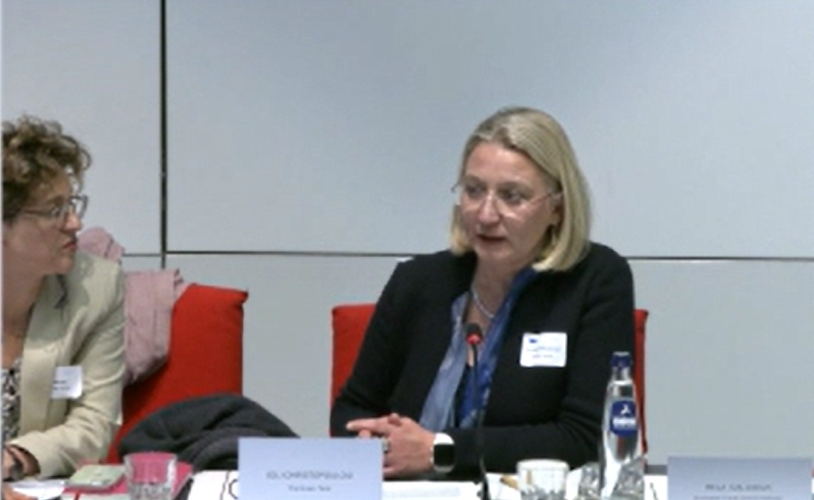
The Green Tank participated in an event titled “Advancing Just Transition: Addressing Social and Economic Impacts and Building Social Support,” organized in Brussels as part of the AdJUST Horizon Europe project, providing an opportunity to exchange views on the present and future of Just Transition.
The opening speech was delivered by Estonian MEP Jana Toom (Renew), rapporteur of the European Parliament’s legislative initiative “on a just transition in the world of work.” Referring first to the challenges faced by the Narva region in Estonia, Jana Toom stressed that the commitment to “leave no one behind” remains highly relevant and requires consistent and coordinated European support.
During the event, the project’s findings were presented, followed by a discussion on the social impacts of the green transition and the policies needed to ensure that climate neutrality advances in a socially just manner.
Ioli Christopoulou took part in an interactive panel on the challenges of Just Transition together with Bela Galgoczi (European Trade Union Institute), Frank Siebern-Thomas (DG EMPL European Commission), and Sebastian Hrib (Brussels Office of the North-East Regional Development Agency, Romania). The discussion was moderated by Ines Omann and Karin Küblböck (ÖFSE).
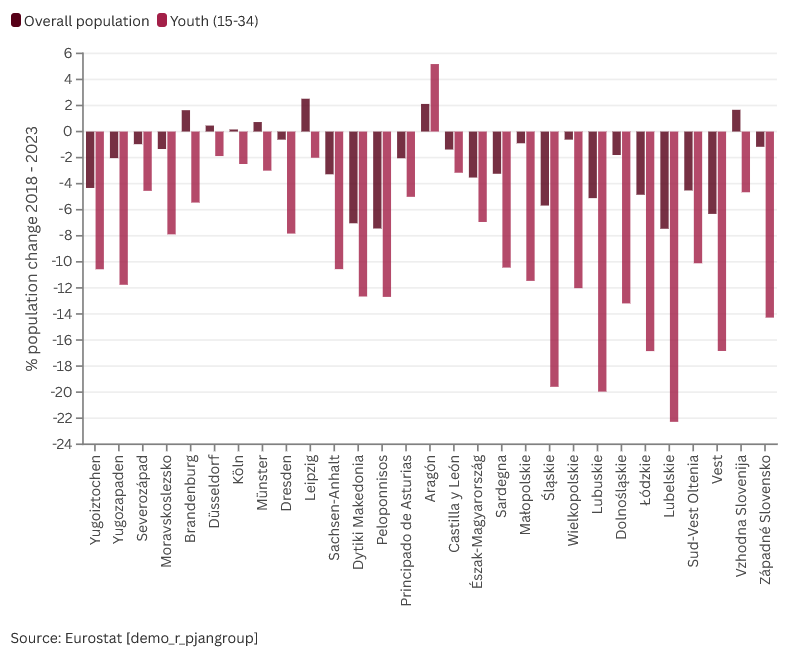
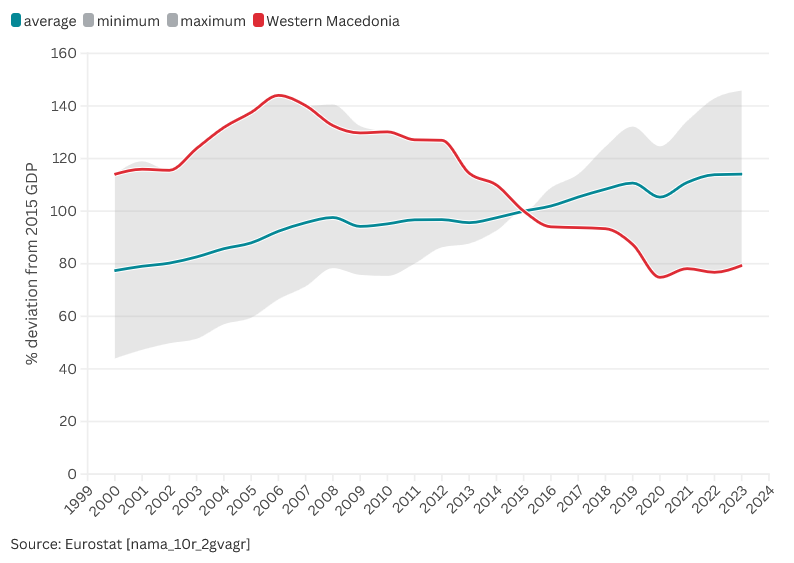
In her intervention, she highlighted the ongoing challenges faced by coal regions across the EU, noting that despite significant funding through the Just Transition Mechanism, many of these regions continue to experience population decline — especially among young people (Figure 1) — as well as marginal economic growth (Figure 2).
She emphasized that Just Transition is a long-term process requiring sustained political commitment and continuous financial support, particularly in light of the planned discontinuation of the Just Transition Fund after 2027, as outlined in the European Commission’s proposal for the 2028–2034 Multiannual Financial Framework.
For this reason, she stressed the importance of including a dedicated chapter, with corresponding resource commitments, for the Just Transition of coal regions in the National and Regional Partnership Plans in the new 2028–2034 programming period. Their design and implementation, she noted, should build on the governance mechanisms that took years to establish and the Territorial Just Transition Territorial Plans, updated as necessary.
She also referred to the broader concept of Just Transition beyond coal regions, and the need to respond to the anticipated social impacts from the implementation of ETS2, which will introduce carbon pricing in buildings and road transport from 2028. As she pointed out, available resources from the Social Climate Fund, as well as other sources, should be directed primarily toward investments that permanently reduce dependence on fossil fuels, rather than temporary direct income support measures.
Finally, she warned that policy choices that lead to ineffective use of resources could intensify social backlash against the green transition and negatively affect public acceptance of the European Green Deal, as well as trust in the European Union itself. The EU and its Member States, therefore, should remain firmly committed to climate policy and provide the necessary support for a Just Transition. This warning is particularly timely in view of the upcoming revision of the EU Emissions Trading System (ETS), where a key issue will be the reduction of free emission allowances for industrial sectors.
The event was co-organized by the Institute for European Environmental Policy and the partners of the AdJUST Horizon Europe project, and was hosted at the European Economic and Social Committee in Brussels on May 12, 2026, with the participation of representatives from European institutions, research organizations, trade unions, and civil society organizations.
Read the full event summary here.


