


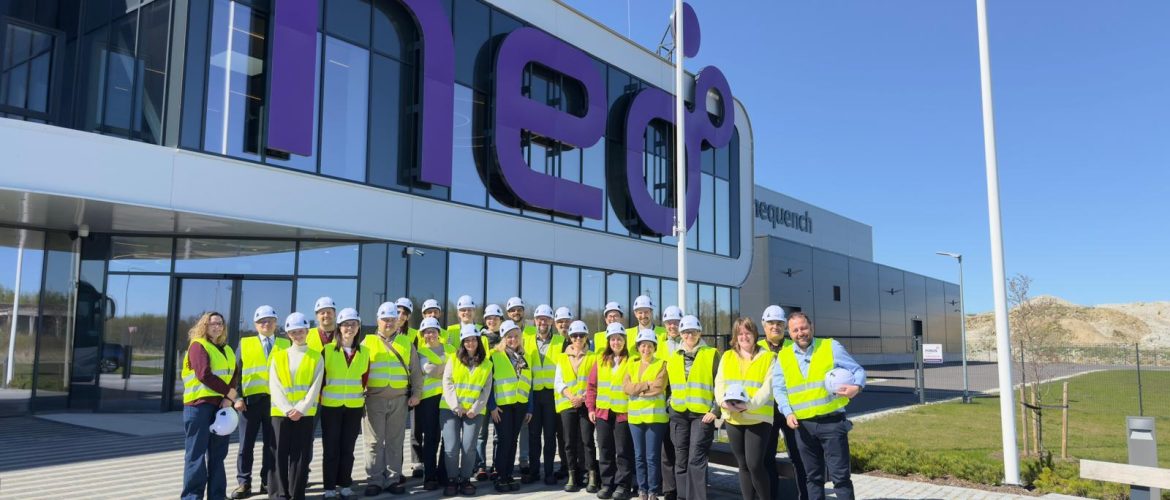
The Green Tank participated in the meeting of the working groups of the European Just Transition Platform, held in Narva, Estonia. During the meeting, participants presented and discussed the outcomes of the working groups, focusing on the future of the Just Transition in the next EU programming period (2028–2034).
Following the meeting, participants — including representatives of the European Commission, local authorities, young people, workers from transition regions, industry, and civil society — visited the region’s new permanent magnet factory, which was funded through the Just Transition Fund.
In Estonia, the transition is closely linked to the gradual phase-out of oil shale, which remains a major source of electricity generation and employment in the Narva region.
The factory is owned by a Canadian company and produces magnets primarily for electric vehicles. Construction was completed in just 500 days, and operations began in 2023. Today, the facility employs around 200 people from 30 different countries — most of them from Estonia — and is expected to expand to 350 employees at full capacity.
The plant has zero direct carbon emissions from its production processes, with emissions arising only indirectly from electricity consumption. So far, electricity has been supplied through the grid, but the company has already begun installing solar PV systems for self-generation in order to reduce energy costs.
The project received €100 million in funding from the Just Transition Fund, out of a total Estonian allocation of €340 million, while the overall investment has already reached €200 million. Notably, the first disbursement was made just two weeks after the approval of Estonia’s national plan.
Planning for both this specific project and Estonia’s broader Just Transition strategy began in late 2019, with meaningful participation from the local community, which identified the creation of new jobs through sustainable investments as a top priority.
The example of Narva shows that when political will is combined with citizen participation and the effective use of European funding, the transition of local economies towards a sustainable development model can become a reality.
Next stop for The Green Tank: participation in a discussion on the present and future of the Just Transition in Brussels on Tuesday, 12 May – More information available here.


