


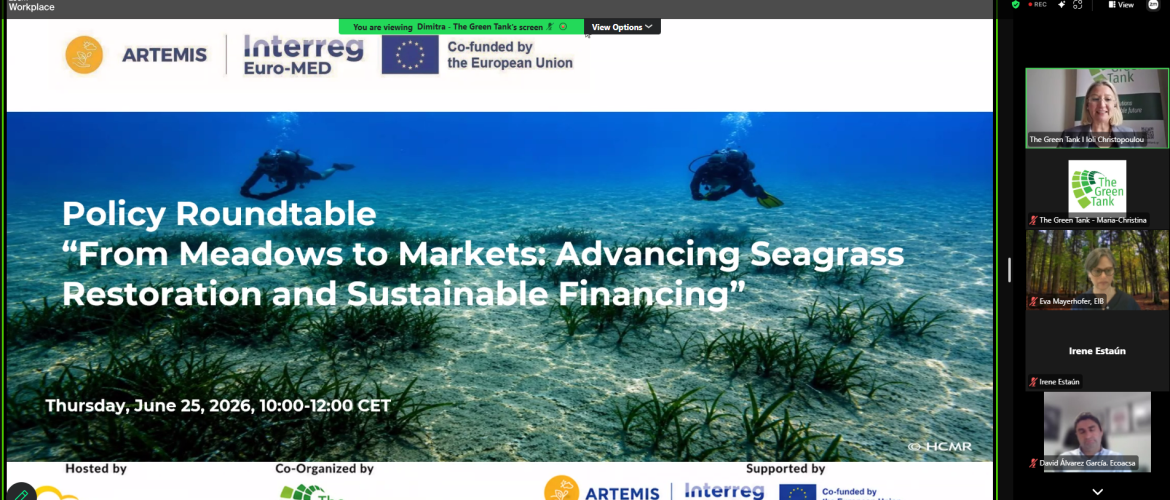
How can the EU scale up the restoration of Mediterranean seagrass meadows? What role can public and private finance play in achieving the ambitious targets of the Nature Restoration Regulation? And under what conditions could innovative financing mechanisms, such as nature credits, support marine ecosystem restoration?
These were the central questions explored during the online policy roundtable “From Meadows to Markets: Advancing Seagrass Restoration and Sustainable Financing“, co-hosted by MEP Dimitris Tsiodras and organised by The Green Tank in the framework of the ARTEMIS Interreg Euro-Med project on June 25, 2026.
More than 80 participants joined the policy roundtable, bringing together representatives from EU institutions, the scientific community, financial organisations and civil society to discuss how to scale up the restoration of Posidonia oceanica, support the implementation of the EU Nature Restoration Regulation, and mobilise innovative financing for healthier and more resilient Mediterranean seas.
The Policy Roundtable featured a welcome greeting from MEP Dimitris Tsiodras, a pre-recorded video message from MEP César Luena, Rapporteur of the EU Nature Restoration Regulation, and an in-depth panel discussion moderated by Ioli Christopoulou, Policy Director, The Green Tank (ARTEMIS partner).
Following a scene-setting presentation by Eugenia Apostolaki, Senior Researcher, Institute of Oceanography, Hellenic Centre for Marine Research (ARTEMIS partner) an in-depth roundtable discussion took place with contributions from Bettina Doeser, Head of Unit, Natural Capital & Ecosystem Health, DG Environment, European Commission, Dimitra Syrou, Nature Policy Associate, The Green Tank, David Álvarez-García, CEO, ECOACSA (ARTEMIS partner), Dominik Maczik, Technical Analyst, Biodiversity Credits Alliance, Eva Mayerhofer, Head of Environmental Policy and Biodiversity, European Investment Bank, and Constantin Tsakas, Chief Economist, Plan Bleu / Regional Activity Center of UNEP MAP (ARTEMIS project coordinator).
The roundtable provided an opportunity to present key outputs of the ARTEMIS project, including its policy recommendations on “Accelerating Seagrass Restoration and Finance” and its proposal for a Posidonia Nature Credit, while fostering an engaging exchange on the governance and financing enabling conditions to turn restoration ambitions into action.
Key Takeaways
- The implementation of the Nature Restoration Regulation now enters its critical delivery phase. National Restoration Plans will provide the central framework for identifying restoration priorities, coordinating implementation, and guiding future public and private investment in marine ecosystem restoration.
- Protecting existing Posidonia oceanica meadows and reducing the pressures affecting them remain the foundation of successful restoration. Active restoration should only be pursued where ecological conditions and scientific evidence demonstrate that natural recovery alone is insufficient.
- Scaling up restoration requires moving beyond isolated pilot projects towards long-term public policy. This will depend on coordinated governance, streamlined permitting, common technical standards, effective monitoring, stable financing and knowledge exchange across the Mediterranean.
- Public funding will remain indispensable for planning, implementation, monitoring and long-term stewardship. Complementary private finance, including innovative financing mechanisms, can help address the financing gap but cannot replace public responsibility for nature restoration.
- Seagrass and marine ecosystem restoration should increasingly be recognised as an investment in natural capital rather than solely as an environmental cost. Achieving restoration targets will require mobilising a diverse financing mix, combining public funding with blended finance and other innovative financial instruments.
- Nature credits have the potential to support marine and seagrass ecosystem restoration if developed within robust scientific, governance and environmental integrity frameworks. They should complement, not replace, public funding or regulatory obligations, respect the mitigation hierarchy, and ensure transparency, additionality, independent verification and long-term monitoring.
- Growing investor interest in biodiversity finance presents an important opportunity, but scaling investment will require a stronger pipeline of investable restoration projects. Clear standards, credible methodologies, predictable revenue models, appropriate risk-sharing mechanisms and project aggregation will be essential to attract private capital.
- The ARTEMIS project demonstrates how ecological restoration, ecosystem service valuation and innovative financing can be brought together in practice. Its experience provides practical lessons that can support the implementation of the Nature Restoration Regulation, inform the work of the European Commission and the Nature Credits Expert Group, and contribute to the development of credible financing mechanisms for seagrass ecosystem restoration.
For the full discussion summary, click here.


