


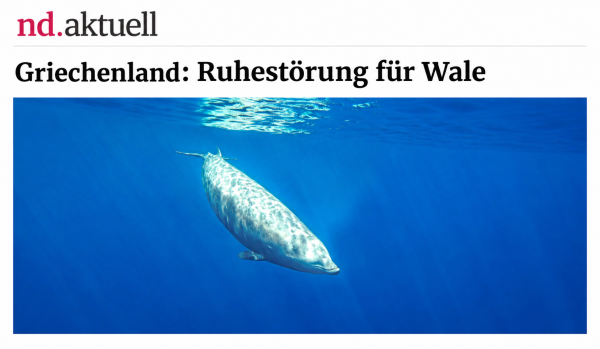
Plans to explore for and potentially extract fossil gas south of the Peloponnese and Crete pose risks to vulnerable marine mammals, while also raising questions about Greece’s climate commitments and the potential economic benefits. In an article published by nd-aktuell.de, Nikos Mantzaris, co-founder and lead policy analyst at The Green Tank, explains why developing new fossil gas deposits could undermine Greece’s path towards climate neutrality.
The article, “Greece: Disturbing the Whales”, examines plans by US energy company Chevron and Greece’s Helleniq Energy to conduct seismic surveys across four offshore concession areas covering approximately 47,000 square kilometres. The surveys, expected to begin in 2026, would use powerful underwater sound pulses to map geological formations beneath the seabed.
New fossil gas deposits and climate targets
Nikos Mantzaris highlights the contradiction between developing new fossil gas deposits and Greece’s commitment to achieving climate neutrality by 2050. Even if the surveys identify commercially viable deposits, production is not expected to begin before the 2030s. Since fossil gas fields are typically designed to operate for 20–30 years, their exploitation could continue well beyond 2050.
Nikos Mantzaris also questions whether extracting fossil gas from Greek waters, if successful, would actually deliver the promised benefits to Greece. Under the concession agreements, the gas would not belong to the Greek state but to the companies, which would sell it to buyers in Greece or abroad at market prices. The Greek state would receive royalties and taxes on profits, provided that profits were made.
As he points out in the article, even if fossil gas were extracted from Greek deposits and consumed in Greece, Greek consumers would still pay prices determined by the European market.
The article also highlights the role of fossil gas-fired power plants in Greece’s electricity-sector emissions. According to Nikos Mantzaris, these plants are already responsible for almost 60% of the sector’s emissions, contributing to the overshooting of the CO₂ emissions budget set out in Greece’s National Energy and Climate Plan.
The prospect of offshore fossil gas extraction therefore raises questions that go beyond the environmental risks to marine ecosystems: are new extraction activities in Greece compatible with the country’s climate targets, as set out in its National Climate Law, and what would the actual economic benefits be for the national economy and its citizens?
Read the full article in nd [in German] here.
Read the translation of the article below:
Greece: Disturbing the Whales
Natural gas exploration is set to begin off the Peloponnese and Crete, posing a threat to rare marine mammals.
The search for oil and gas is increasingly shifting offshore. According to Global Energy Monitor, in 2024, ten offshore fields accounted for 85 percent of the expected production volume from newly discovered oil and gas deposits worldwide. However, the environmental damage caused by offshore oil and gas projects begins long before production might start. This is because seismic surveys are already used when searching for suitable deposits.
Such surveys to explore for natural gas off the coast of Greece are expected to begin as early as 2026. The US energy company Chevron and the partially state-owned Greek energy company Helleniq Energy have been awarded concessions for four offshore blocks south of the Peloponnese peninsula and Crete. Chevron holds a 70 percent stake in the project and will act as the operator, while Helleniq Energy holds the remaining 30 percent. The concession areas cover approximately 47,000 square kilometers.
Habitat for Whales
The planned surveys concern an area of the Mediterranean that is particularly important for marine mammals. Endangered sperm whales and Cuvier’s beaked whales inhabit the Hellenic Trench, a deep-sea trench between the Ionian Sea and Rhodes. Estimates of the sperm whale population in the eastern Mediterranean vary: in 2022, Ocean Care cited approximately 200 to 250 animals, while the Pelagos Cetacean Research Institute estimated between 110 and 150.
While the airguns were active, 70 percent fewer fin whale calls were recorded than during quieter periods.
For sperm whales, the Hellenic Trench is an important feeding ground. The animals typically dive to depths of several hundred meters to 2,000 meters to hunt squid. As the largest toothed whales in the world, they orient themselves using clicks, which they also use to locate food. Characteristic sequences of clicks, known as codas, also serve as a means of communication. A 2023 study identified genetic differences between sperm whales in the Mediterranean and those in the North Atlantic. Because the population is small and distinct, and the Hellenic Trench provides a central habitat for these animals, any further losses could have particularly serious consequences.
Cuvier’s beaked whales also use the area’s deep waters. Its designation as an Important Marine Mammal Area (IMMA) underscores the importance of this habitat for marine mammals.
WWF Greece describes the area as a refuge for whales and dolphins. “Marine mammals can still find suitable habitat here in a Mediterranean that is coming under increasing pressure,” says George Chasiotis, the organization’s senior legal adviser. It is therefore essential to protect marine mammals from oil and gas drilling, seismic surveys, and pollution, he says, “in order to preserve these endangered populations and support the recovery of marine ecosystems in Greek waters.”
However, the planned seismic surveys will expose whales to a specific form of disturbance: underwater noise. Research vessels use devices known as airguns to conduct these surveys. At short intervals, the devices emit powerful sound pulses that travel through the seabed and are reflected by different rock layers. These reflections can then be used to create images of the geological structures beneath the seabed.
Disrupted Communication
Because whales communicate primarily through sound, these sound pulses can have far-reaching effects on their ability to navigate and find food. “Among the most serious consequences are temporary or permanent hearing damage, which can impair the animals’ ability to communicate, navigate, avoid danger, and locate prey,” explains Chasiotis of WWF. “Exposure to seismic noise can also trigger significant behavioral changes, disrupting activities such as feeding, resting, diving, and migration patterns.”
Studies from other marine regions demonstrate the effects on whales. A study published in the journal Scientific Reports in 2026 analyzed 63 days of underwater recordings from a seismic survey off northwestern Spain. While the airguns were active, an average of 70 percent fewer fin whale calls were recorded than during quieter periods. Even after correcting for calls that may have been masked by the noise, the decline was still 52 percent. It remained unclear whether the animals called less frequently or moved away from the area.
A 2023 report prepared by Ocean Care for the United Nations Convention on the Conservation of Migratory Species of Wild Animals (CMS) puts the nominal source level of seismic airguns—the sound intensity measured close to the source—at around 260 decibels. For comparison, pile driving for offshore wind turbine foundations using a hydraulic hammer with an impact energy of 1,000 kilojoules is reported to produce around 237 decibels, while a cargo ship produces 192 decibels within a particular frequency range. However, the authors caution that these values are only comparable to a limited extent because the sounds have different characteristics. Ships primarily generate continuous noise, whereas airguns and pile-driving operations produce repeated impulses. The extent to which marine mammals are affected depends, among other factors, on the frequency, duration, repetition, and distance from the source.
Legal Concerns
Beyond the potential consequences for wildlife, questions remain about whether the environmental assessments for such projects meet legal requirements. Francesco Maletto, a lawyer at the environmental law organization ClientEarth, criticizes the fact that environmental assessments for previous oil and gas projects in Greece were, in some cases, based on outdated data. He says the assessments required under EU law were not adequately carried out for seismic surveys.
In 2023, ClientEarth therefore filed a complaint with the European Commission together with WWF Greece and Greenpeace Greece. The complaint is still pending. According to Maletto, it does not target the new Chevron concessions, but the structural problems it identifies could also be relevant to other permitting procedures.
In response to an inquiry, Chevron referred to its general corporate principles. “Wherever Chevron operates, protecting our employees, communities, the environment, and our assets is a priority,” a company spokesperson said. “It is company policy to comply with all applicable regulatory requirements and permit conditions.” The statement does not specify what concrete measures are planned to protect marine mammals, such as acoustic monitoring or suspending surveys when whales are sighted.
A study published in April 2026 in the journal Ethics in Science and Environmental Politics offers an indication of the risks these activities could pose to wildlife. The researchers analyzed controversial case studies from the Mediterranean in which established protective measures intended to reduce harmful impacts on the region’s native marine megafauna—including whales, dolphins, seals, and sea turtles—were not followed. Their conclusion: “Even if these failures do not clearly constitute a violation of legal obligations, they demonstrate unethical conduct.”
At Odds with Climate Targets
Nikos Mantzaris of the think tank The Green Tank also sees the planned gas projects as conflicting with Greece’s climate targets. In line with EU objectives, Greece has committed to achieving climate neutrality by 2050. Even if the planned seismic surveys were to identify commercially viable gas deposits, gas production would not be expected to begin until the 2030s at the earliest, Mantzaris says. Planned gas fields are often designed to operate for 20 to 30 years. The consequence, he warns, is that “new production would therefore continue well beyond 2050.”
The government of Prime Minister Kyriakos Mitsotakis, by contrast, justifies the search for new deposits on the grounds that it aims to make the country’s energy supply more independent. In 2024, the Greek state-owned company responsible for managing hydrocarbon and energy resources estimated the potential gas reserves in Greek waters at approximately 680 billion cubic meters—mathematically enough to cover around 100 years of current consumption, which stands at approximately six billion cubic meters annually.
According to Mantzaris, however, it remains unclear whether the gas would actually benefit Greece’s energy supply. “Under the lease agreements, the gas belongs to the companies, which can sell it at market prices to any buyers, either domestically or abroad,” he says. The Greek state would receive royalties from production but would have no claim to the gas being used within the country. “Greek consumers would still have to pay European market prices.”
Mantzaris is also critical of gas production from a climate policy perspective. Gas-fired power plants are “already responsible for almost 60 percent of emissions in the electricity sector.” The expert sees this as the “main reason why the sector is exceeding the CO₂ budget established under the national climate protection law.” The new gas fields could remain in operation long after 2050, with consequences for marine mammal habitats and Greece’s goal of achieving climate neutrality.


