


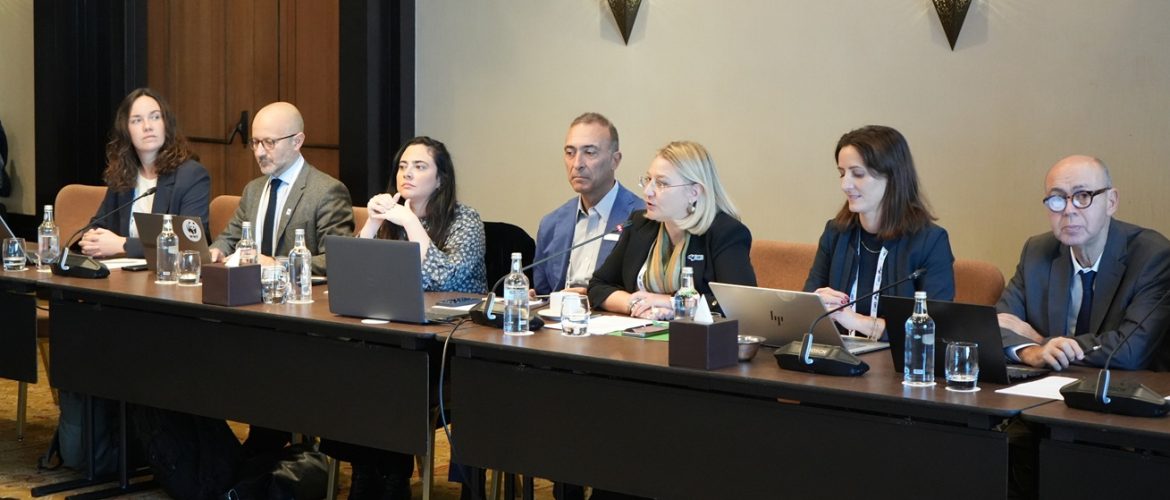
On the occasion of the 24th Meeting of the Contracting Parties to the Barcelona Convention (COP24), The Green Tank co-organized and moderated a side event titled “From Science to Action: Strengthening Conservation and Cooperation for Priority Mediterranean Species and Habitats” that was held on 4 December 2025 at the St. Regis in Cairo, Egypt. The event brought together leading scientific initiatives, regional institutions, and policy actors working to advance marine conservation across the Mediterranean.
The session was co-organized by ACCOBAMS and the ACCOBAMS Survey Initiative-II (ASI-II) partners, MEDASSET and the LIFE MareNatura project, the French Biodiversity Agency (OFB), and members of the Mediterranean Posidonia Network.
Ioli Christopoulou, Policy Director of The Green Tank, moderated the discussion, emphasizing the need to translate scientific knowledge into actionable regional policy.
Advancing Knowledge of Priority Species and Habitats
During the event, the co-organizers presented their initiatives and how they are helping us better understand priority Mediterranean species and habitats. In particular:
Simone Panigada, Scientific Coordinator of ASI-II and Chair of the ACCOBAMS Scientific Committee, presented the second edition of the ACCOBAMS Survey Initiative. Building on the 2018 survey, ASI-II will provide standardized, comparable, and updated data on cetaceans and other megafauna, enabling long-term trend analysis and helping identify priority areas for conservation action.
Nadia Andreanidou, Programmes and Policy Officer at MEDASSET, outlined the expanded scope of the LIFE MareNatura project. By integrating multiple taxonomic groups and assessing threats such as bycatch, vessel strikes, noise, and habitat degradation, the project helps Greece and Italy propose and design climate-resilient marine protected areas and protect priority species under changing environmental conditions.
Eva Sahores (French Biodiversity Agency) and Mauro Randone (WWF Mediterranean Marine Initiative), representing the Mediterranean Posidonia Network, presented collaborative efforts to monitor, protect, and restore Posidonia oceanica seagrass meadows. Harmonized methodologies and regionally comparable data strengthen the recognition of seagrass habitats as biodiversity hotspots and natural climate solutions.

From Science to Regional Action
A high-level panel with Yaprak Arda (Marine Programme Officer, Marine Biodiversity & Blue Economy, IUCN Mediterranean), Elyes Hamza (Director, SPA/RAC), and Maylis Salivas (Executive Secretary, ACCOBAMS), explored how these initiatives support regional biodiversity strategies.
Yaprak Arda highlighted how projects like ASI-II and LIFE MareNatura provide the high-quality, fine-scale data needed for biodiversity assessments and the identification of Key Biodiversity Areas (KBAs). She explained that these analyses inform Marine Protected Area (MPA) designation, strengthen existing MPA networks, support the 30×30 target, and guide the identification of Other Effective Area-Based Conservation Measures (OECMs).
Noting that projects, such as those presented during the side event, provide the evidence base for where new MPAs or OECMs should be established, Elyes Hamza highlighted that these initiatives are examples of how regional conservation action can be scaled up. He also stressed that achieving the 30×30 target is possible, but only with political commitment, sustainable financing, and strong regional coordination.
On her part, Maylis Salivas noted that the ASI-II which is based on harmonized protocols, shared data, and capacity building, ensures that science is translated into concrete policy, from identifying important areas to developing management plans. As such, ASI-II supports UNEP-MAP priorities, including biodiversity and marine litter objectives.
Biodiversity and Climate Synergies
The speakers also highlighted the climate relevance of these projects, emphasizing the need to integrate climate change considerations into the design of conservation measures, such as species action plans and the designation of new protected areas, while also noting that restored ecosystems, like Posidonia meadows, provide nature-based solutions for climate mitigation and adaptation.
Government engagement
Government representatives, attending the event, underlined the policy relevance of the scientific advances reflected by these initiatives.
Petros Varelidis, General Secretary of Natural Environment and Water, Ministry of Environment and Energy, Greece, stressed the importance of open and accessible data for decision-making, while Marina Argyrou, on behalf of Dr Maria Panayiotou, Minister of Agriculture, Rural Development and Environment, Cyprus, highlighted national progress and the need to turn science into action.
Catherine Chabaud, Minister Delegate for the Sea and Fisheries of France, concluded by emphasizing the importance of initiatives such as the Mediterranean Posidonia Network, which is supported by the French Biodiversity Agency as well as ASI-II and LIFE projects that reflect the necessary regional collaboration approach, in informing effective conservation measures to ensure a resilient Mediterranean Sea.


