


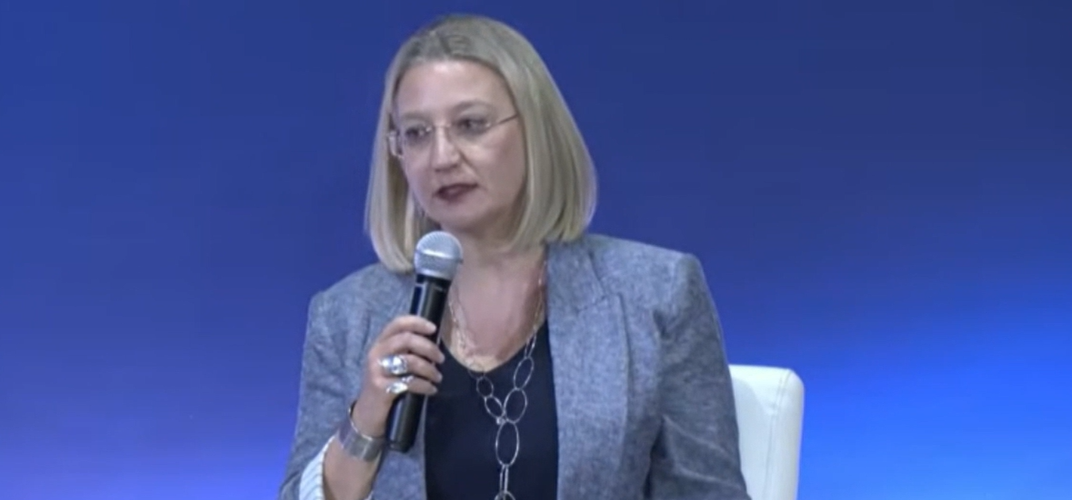
Funding for the transition of Greece’s lignite regions must continue during the next programming period (2028–2034). This was among the key messages delivered by Ioli Christopoulou at the event “Cohesion Policy 2028–2034 | National and Regional Partnership Plan“, organised by the General Secretariat for the Partnership Agreement (NSRF) of the Ministry of National Economy and Finance on 9 July 2026 at the Athens Conservatoire (Odeon of Athens).
The event marked the launch of the consultation process on the European Union’s Cohesion Policy for the 2028–2034 programming period. It forms part of the broader process of defining Greece’s national and regional development priorities and preparing the country’s National and Regional Partnership Plan (NRPP) for 2028–2034.
Responding to a question from the discussion moderator, journalist Thodoris Georgakopoulos, Ioli Christopoulou stressed that the transformation of Greece’s lignite regions has not—and could not have—been completed. While Greece was among the Member States that moved quickly to make use of the Just Transition Fund (JTF) and has already committed a large share of the available resources to projects, implementation remains slow. At the same time, the restoration of former lignite mining sites is progressing at a limited pace. This largely explains why unemployment and regional GDP—particularly in Western Macedonia—have not yet shown significant improvement. Consequently, supporting the transition of lignite regions should remain a national priority in the next programming period.
More specifically, she proposed the inclusion of a dedicated chapter on the Just Transition of lignite regions in Greece’s National and Regional Partnership Plan (NRPP), in line with proposals already put forward by the three European Parliament committees responsible for the relevant Regulation—BUDG, REGI and AGRI.
She further suggested that this chapter should build on the same priority axes as the existing Territorial Just Transition Plans (TJTPs), while reallocating resources on the basis of an assessment of the programme’s implementation to date. This would ensure that funding is directed towards the most effective measures for reducing unemployment, limiting youth outmigration and increasing regional GDP.
In her intervention, Ioli Christopoulou also argued that the perceived trade-off between the green transition and industrial competitiveness is a false dilemma. This is already evident in sectors such as Greece’s major cement industry, where companies have significantly reduced their carbon footprint while simultaneously investing in major decarbonisation projects. Any rollback of climate policy, she noted, would therefore undermine not only climate objectives but also the competitiveness of Greek industry.
She concluded by stating: “The choice is not between the green transition and competitiveness. The competitiveness of the Greek economy will depend precisely on how effectively we advance the green transition. And there can be no green transition unless it is also a just transition.”
Responding to a final question on the measures needed to integrate nature restoration into Greece’s development strategy, Ioli Christopoulou stressed that protecting nature alone is no longer sufficient in the face of accelerating ecosystem degradation and the climate crisis. Nature restoration is emerging as a new policy priority, as natural capital constitutes the foundation of the country’s economy, productivity and resilience. Under the new EU Nature Restoration Regulation, Greece is currently preparing its National Restoration Plan, which must be supported by adequate financial resources to ensure its effective implementation.
A key prerequisite, she noted, is the integration of nature restoration into the country’s development planning and the new Partnership Agreement (NSRF) through additional funding. This is essential to avoid the delays and shortcomings observed in other environmental policy areas, such as water management and waste management. Greece possesses significant natural capital, which represents a major comparative advantage. Investing in ecosystem restoration is not an environmental cost but an investment in prevention, resilience, competitiveness and the country’s sustainable development.
Joining Ioli Christopoulou in the discussion were Dimosthenis Anagnostopoulos, Secretary General for Information Systems and Digital Governance; Panagiotis Liargovas, Professor of Economics at the University of the Peloponnese; Maria Gavouneli, President of the National Commission for Human Rights (GNCHR); Apostolis Dimitropoulos, Special Adviser on Education Policy at the Presidency of the Government and former Secretary General for Higher Education; and Christos Goulas, Director General of the Labour Institute of the Greek General Confederation of Labour (INE GSEE).
You can watch:
- the highlights of Ioli Christopoulou’s intervention [in Greek] here.
- the full event [in Greek] here.


