


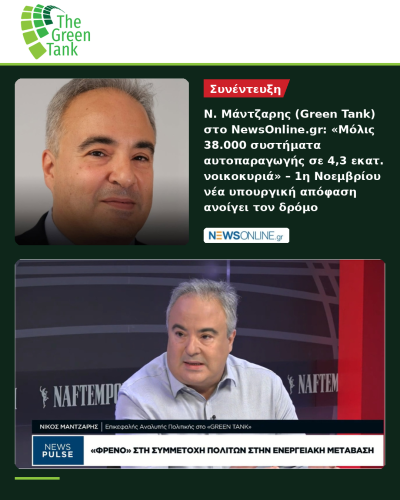
The role of self-generation and Energy Communities in reducing energy costs, as well as the barriers that continue to hinder their development, was discussed by Nikos Mantzaris, Policy Analyst and co-founder of The Green Tank, in interviews with Naftemporiki TV and NewsOnline.
Currently, only 38,000 self-generation systems are operating across approximately 4.3 million households, while the number of new applications has fallen sharply in recent years. As Nikos Mantzaris explained, tackling the root causes of the energy crisis requires reducing dependence on fossil fuels, as the use of fossil gas drives electricity prices upwards. Enabling consumers to use the renewable energy they generate themselves, either individually or through Energy Communities, can make a meaningful contribution to lowering electricity bills.
However, the development of new self-generation projects continues to face significant barriers, including limited grid capacity and a lack of dedicated funding, particularly for Energy Communities formed by citizens and businesses. Although the new Ministerial Decision on self-generation is a positive development that could help revive the market, it is not enough on its own. Substantial funding, priority access to grid connections, reserved grid capacity and systematic public information are needed to enable more households — particularly those experiencing energy poverty — to benefit from self-generation.
Nikos Mantzaris also highlighted the importance of energy storage in making better use of low-cost renewable electricity, reducing renewable energy curtailment and limiting reliance on expensive fossil gas. As he noted, Greece has approximately 700 MW of battery storage capacity, compared with around 5,400 MW in Bulgaria, highlighting Greece’s lag in developing energy storage.
In this context, he recalled that environmental organisations had proposed an alternative when the Ptolemaida 5 lignite power plant was being built: energy storage systems using pumped hydropower, combined with wind and solar power, to ensure a steady electricity supply throughout the day. As he pointed out, Ptolemaida 5 cost at least €1.5 billion to build, yet the plant is expected to cease operating just three years after it began operations.
Together, the two interviews highlight how self-generation and energy storage can help reduce energy costs and dependence on fossil fuels. Realising their potential will require an effective regulatory framework and concrete measures to make these solutions more accessible to citizens.
Watch and read the interviews:
- Naftemporiki TV, 1 October 2026: Watch the full interview [in Greek] to Kostas Kaletsios and Christina Kousouni
- NewsOnline, 7 October 2026: Read the full interview [in Greek] to Christina Kousouni


