


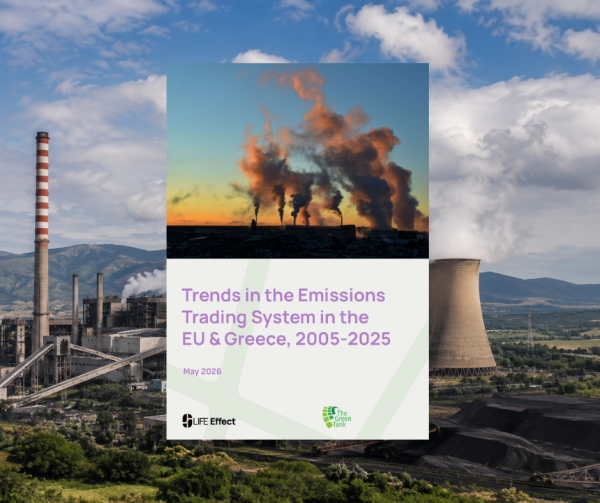
Emissions from the four sectors covered by the EU Emissions Trading System (EU ETS) in the EU-27 remained largely unchanged in 2025 (-1.7%). At the same time, lignite and hard coal continued to account for 46% of emissions in the power and heat sector. In Greece, emissions from this sector increased due to higher fossil gas use, while the country recorded the highest maritime emissions in the EU. By contrast, the carbon footprint of the Greek cement industry fell by 9.2%, and that of refineries by 4.6%.
The new report by The Green Tank, titled “Trends in the EU Emissions Trading System in the EU and Greece (2005–2025)”, examines emissions trends across the four EU ETS sectors: power and heat generation, industry, aviation, and maritime transport. The analysis covers the period 2005–2025 and is based on the latest data from the Union Registry and the European Environment Agency (April 2026).
The main findings are as follows:
European Union
- In 2025, emissions from the four EU ETS sectors in the EU-27 reached 1,137 million tonnes of CO₂, just 1.7% lower than in 2024
- Emissions from power and heat generation and industry fell to 994.3 million tonnes in 2025, 7% below 2005 levels, but still short of the ETS Directive target of a 62% reduction by 2030. Portugal (-70.3%) and Denmark (-70.2%) achieved the largest cuts, while Cyprus (-14.7%) and Austria (-29%) recorded the weakest progress.
- Although lignite and hard coal generated only 9.2% of electricity in 2025, they emitted 263.2 million tonnes of CO₂, accounting for 46% of emissions from the power and heat sector. Poland’s Bełchatów Power Station remained by far the EU’s most polluting installation, emitting 25.1 million tonnes of CO₂ — more than the entire power and heat sector of France.
- Industrial emissions declined by only 2.6% in 2025. Among the four most carbon-intensive industrial sectors, chemicals recorded the largest drop (-5.5%), followed by steel (3.8%) and cement (3.1%), while refineries saw the smallest decline (-1.1%).
- Germany’s steel industry remained the EU’s highest-emitting industrial sector, releasing 24.2 million tonnes of CO₂ in 2025, despite recording the largest annual decrease due mainly to lower production.
- Aviation emissions plateaued in 2025, remaining at 60.1 million tonnes of CO₂, while maritime emissions declined slightly from 86 million tonnes in 2024 to 82.7 million tonnes in 2025.
Greece
- Greece ranked 8th in the EU-27 in terms of emission reductions from power and heat generation and industry over 2005–2025 (-62.7%), falling two positions compared to last year. The year-on-year reduction was just 1.8%.
- Despite the continued decline of lignite, emissions from the power and heat sector increased in 2025 to 15.9 million tonnes, driven by a sharp rise in fossil gas use. Gas-fired plants accounted for 8.8 million tonnes of CO₂ (55% of sector emissions).
- Industrial emissions fell by 5% (11.7 million tonnes), nearly double the EU-27 average decline (-2.6%). The reduction was driven mainly by improvements in the two most carbon-intensive sectors, with emissions falling by 9.2% in cement production and 4.6% in refineries.
- Greece recorded the highest maritime emissions in the EU-27, at 15.4 million tonnes—comparable to emissions from its entire power and heat sector (15.9 million tonnes).
- The most polluting installation in 2025 remained the Agios Dimitrios lignite power plant, emitting 2.7 million tonnes of CO₂. It was followed by three refineries, while the newest fossil gas plant (Agios Nikolaos II) ranked fifth.
“The climate crisis is not a luxury that can be postponed in times of geopolitical instability or economic pressure. On the contrary, the energy crisis that followed Russia’s invasion of Ukraine clearly exposed the cost of Europe’s dependence on fossil fuels—a dependence that persists today. The upcoming revision of the EU ETS is an opportunity for the EU-27 to accelerate its phase-out of fossil fuels, which remains the only reliable pathway to strengthening the resilience and competitiveness of the European economy,” said Nikos Mantzaris, Lead Policy Analyst at The Green Tank.
Notes to editors:
- Read the full report: “Trends in the EU Emissions Trading System in the EU and Greece (2005–2025)” here.
- The analysis was conducted under the LIFE Effect project (LIFE23 GIC BE LIFE EFFECT), which aims to strengthen knowledge, capacity, and networking among civil society and stakeholders on two key EU climate policy instruments: ETS2 (for buildings and road transport) and the Social Climate Fund.
- More information on the EU ETS can be found in the EU ETS 101 guide, developed under the LIFE ETX project.


