


PRESS RELEASE
As EU Member States prepare their National Restoration Plans under the EU Nature Restoration Regulation and engage in negotiations on the priorities of the 2028–2034 Multiannual Financial Framework, a new report from the Interreg Euro-MED ARTEMIS project highlights what is needed to move from the legal protection of Posidonia meadows to the systematic implementation of restoration actions at national and Mediterranean scale [1].
The report, “Accelerating the Restoration of Seagrass Meadows in the Mediterranean through Innovative Ecosystem-Service Based Solutions: Policy Recommendations”, brings together lessons from the ARTEMIS pilot actions in Greece, Italy and Spain and sets out 15 policy recommendations to strengthen the governance, implementation and financing of Posidonia meadow restoration across the Mediterranean.
The new report confirms that similar challenges are found across different Mediterranean countries, underscoring the need for more coherent policies and better coordination across all levels of governance. It also highlights that Posidonia restoration requires adequate and long-term funding. While public funding must remain the main pillar supporting restoration efforts, the report also explores complementary financing mechanisms, such as Nature Credits and more specifically Posidonia Credits, under strict conditions of credibility and environmental integrity.
“Although nature restoration is now firmly on the European policy agenda, the governance and financing conditions needed to deliver it at scale are still lacking. The ARTEMIS policy recommendations provide concrete directions for turning ambition into action,” said Ioli Christopoulou, Policy Director and co-founder of The Green Tank.
Advancing Posidonia restoration in Greece
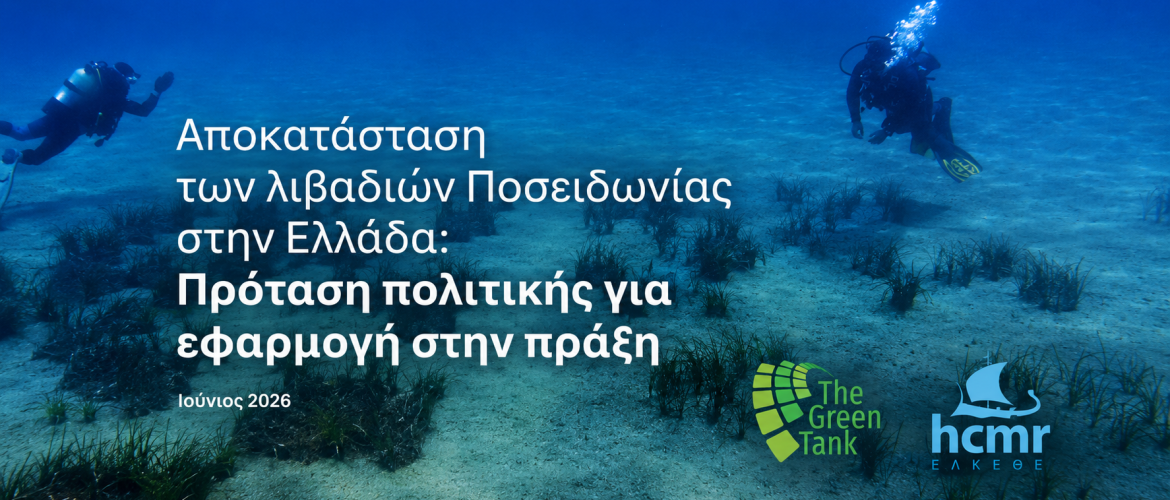
For Greece, these recommendations are further developed [in Greek] in the document “Restoring Posidonia Meadows: A Policy Proposal for Implementation in Practice”, jointly prepared by The Green Tank and Dr. Eugenia Apostolaki, Dr. Vassilis Gerakaris and Dr. Maria Salomidou (Institute of Oceanography, Hellenic Centre for Marine Research – HCMR) in the framework of the ARTEMIS project, with the aim of creating a functional, coherent and implementable framework for Posidonia meadow restoration.
The proposal covers the full restoration cycle, from spatial identification to implementation and monitoring of interventions. More specifically, it proposes:
- clarifying the responsibilities of the authorities involved,
- identifying Restoration Areas,
- preparing Restoration Action Plans,
- establishing dedicated technical guidance based on scientific protocols, and
- strengthening monitoring, evaluation and adaptive management mechanisms.
It also proposes targeted administrative and regulatory measures concerning the permitting of restoration projects and the concession of seabed areas.
The proposal is based on an analysis of the existing policy and regulatory framework, consultations with relevant stakeholders [2], and specialised scientific expertise. This process highlighted both the broad recognition of the value of Posidonia meadows and the significant scientific know-how available in Greece, as well as key weaknesses that continue to hinder the practical implementation of restoration actions.
The scientific basis of the proposal is the recent report “Restoration of Posidonia Meadows (Posidonia oceanica): Scientific Guidelines and Implementation Proposals” [in Greek], together with its annexes [3]. The report which forms an integral part of the proposal, presents a comprehensive approach to Posidonia meadow restoration, taking into account the existing regulatory framework, the available scientific knowledge and the specific characteristics of the Greek coastal environment.
“The aim of this proposal is to help ensure that Greece is adequately and timely prepared to implement Posidonia meadow restoration actions in line with its European and national commitments. If adopted, it could also serve as a model for other Mediterranean countries facing similar challenges,” said Dimitra Syrou, Nature Policy Associate at The Green Tank.
“Restoring Posidonia requires a combination of scientific knowledge, institutional readiness and adequate funding. The research we are conducting and the pilot applications we are testing provide the scientific guidance needed for restoration actions and can contribute to achieving national and European biodiversity targets while strengthening climate resilience,” noted Eugenia Apostolaki, Senior Researcher at the Institute of Oceanography of HCMR.
The policy proposal “Restoring Posidonia Meadows: A Policy Proposal for Implementation in Practice” is available [in Greek] here.
The 15 ARTEMIS policy recommendations are available here.
Notes to editors
- The Interreg Euro-MED ARTEMIS project (Accelerating the Restoration of Seagrass Meadows in the Mediterranean Area through Innovative Ecosystem-Service Based Solutions) aims to improve restoration techniques for Posidonia meadows, assess the ecosystem services they provide, and develop innovative tools to integrate them into both policymaking and investment decisions. The project was implemented by ten partners across five European and Mediterranean countries, with Plan Bleu as project coordinator, from January 2024 to June 2026.
- In particular, the following activities were carried out:
- 17 in-depth interviews with representatives of institutional and scientific bodies,
- an interactive workshop with around 50 participants in Heraklion, Crete,
- targeted consultations with relevant authorities, including the Greek Ministry of Environment and Energy and OFYPEKA, and
- a working meeting with relevant stakeholders held in the framework of the 1st Greek Seagrass Forum.
- Gerakaris, V., Apostolaki, E., Salomidou, M. (2026). Restoration of Posidonia Meadows (Posidonia oceanica): Scientific Guidelines, Implementation Proposals, Technical Implementation Guide and Decision-Support Tools. HCMR, Institute of Oceanography. p. 67. https://doi.org/10.5281/zenodo.19401230
- The publication of the report comes at a particularly timely moment, as Member States are required to submit the first drafts of their National Restoration Plans to the European Commission by 1 September 2026. The report’s recommendations were recently presented during the online policy roundtable “From Meadows to Markets: Advancing Seagrass Restoration and Sustainable Financing”, co-hosted by MEP Dimitris Tsiodras and The Green Tank במסגרת the ARTEMIS project on 25 June 2026, with the participation of representatives from EU institutions, the scientific community, the financial sector and civil society organisations.


