


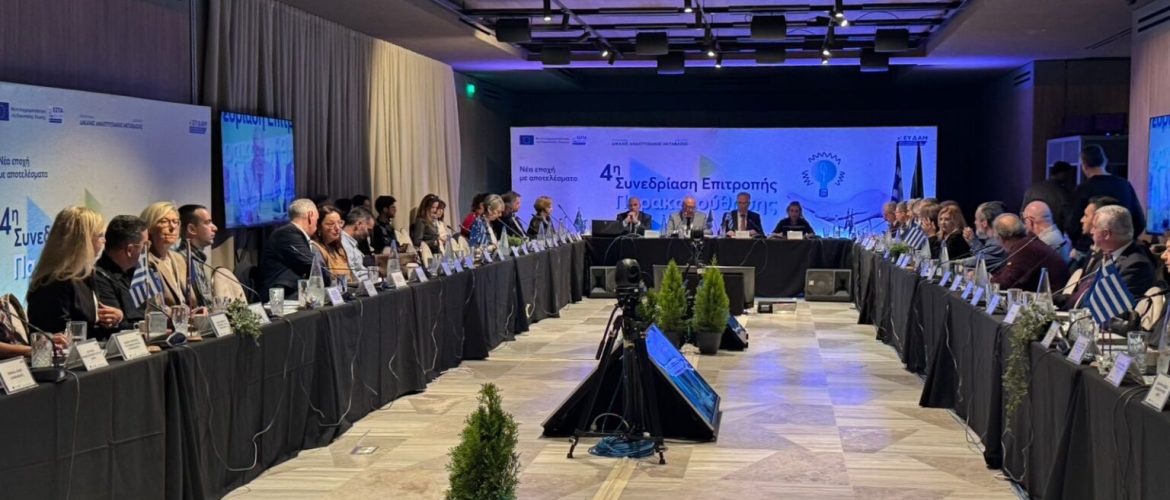
The Green Tank participated in the 4th meeting of the Monitoring Committee, which took place at Zappeion on December 2, 2025. The main objective was the overall assessment of the course of the Program with emphasis on progress during the third year of its implementation. Despite the progress made in supporting entrepreneurship in lignite regions, support for youth entrepreneurship and self-production projects by energy communities remains limited, while delays are noted in the implementation of the heat pump installation program in Western Macedonia.
According to the most recent available data, by early December 2025, out of the total amount of €1.624 billion of the Program €1.338 billion (82.4%) has been allocated. Calls for proposals totaling €1.177 billion (72.4%) have been published, while the inclusion of projects in the Program reaches €848 million (52.2%). Legal commitments amount to €592 million (36.5%). Nevertheless, the actual expenditure is limited to €105 million (6.5%), an amount significantly lower than the €322 million that EYDAM had estimated a year earlier (December 2024) as the expected level of expenditure for 2025.
The most significant progress is recorded in Priority 1 of the PDAM, which concerns actions to support and promote entrepreneurship and has the lion’s share of the Program’s resources. The calls, totaling €821.9 million, exceed the approved budget of the Priority (€734.1 million). reaching 112%. Actions worth €550.5 million (75%) have been included, while legal commitments concern €400.2 million (55%). The actual expenditure amounts to €67.1 million. However, no call has been published specifically targeting the strengthening of youth entrepreneurship in Western Macedonia, despite the relevant official statements made in 2024.
In contrast to Priority 1, Priority 2, which includes projects for the Energy Transition and Climate Neutrality, shows strong stagnation. Calls for proposals amounting to €130.4 million have been issued, corresponding to 54% of its initial budget (€234.2 million). However, the inclusions are limited to projects worth only €32.7 million (13%), the legal commitments do not exceed €1.9 million, while the expenditure is below €250 thousand (0.1%). It is no coincidence that during the recent revision of the Energy Community Development Plan, four calls with a total budget of €140 million were transferred from Priority 2 to Priority 1, with the aim of supporting investment projects of new, start-up and existing enterprises of all sizes, to promote energy production from RES, renewable hydrogen and high-efficiency cogeneration.
The picture regarding the Priority 2 call for self-generation projects by energy communities, which was published more than two years ago, in September 2023, is particularly problematic. The only development during last year concerns the inclusion of self-generation projects with a total capacity of 8.92 MW by the energy community of the Municipality of Voio, which are added to the 7 MW of self-generation by the energy community of the Municipality of Kozani that were included last year. Significant delays are also observed in the heat pump program for the Region of Western Macedonia, with a budget of €12 million, for which the relevant call was also published in September 2023. The announcements from the Regional Development Fund of Western Macedonia, which is the implementing body, are now expected in early 2026.
Even greater inertia is recorded in Priority 3, which concerns Land Use Adjustment and Circular Economy, as no new call was issued during 2025. As a result, the picture remains unchanged compared to 2024, when there was only one call in force for the rehabilitation of the Vegora mines, amounting to €30.4 million. This action, which corresponds to 49% of the total budget of Priority 3 (€62 million), did not progress to the inclusion stage in 2025 either.
In 2025, only four calls were issued for a total of €21.9 million under Priority 4, which concerns the Labor Transition. In total, since the start of the Program, the calls amount to almost €143 million, an amount corresponding to 47% of the initial budget of Priority 4 (€305.6 million). Integrations reach €173.5 million (57%), legal commitments €116.6 million (38%), while expenditures amount to €28.2 million (9%).
Priority 5, which was recently created in the context of the revision of the Regional Development Plan and includes exclusively actions for the South Aegean Region, shows limited progress. Only one call for proposals has been issued for €3 million, corresponding to 4% of the total budget of €68.6 million, while projects worth €2.8 million have been included in the PDAM.
On the contrary, Priority 6, which concerns Technical Assistance and mainly supports the operation of the managing authority (EYDAM), is progressing without obstacles. Calls for proposals totaling €47.9 million have been issued, corresponding to 84% of the available budget of €57.2 million. In addition, €43.4 million (76%) have been included, €33.8 million (59%) are accompanied by legal commitments, while the actual expenditure amounts to €9.1 million (16%).
The situation regarding the transfer of lands from PPC to the State through “Metavasi S.A.” remains unclear. There has been only one relevant reference during the meeting regarding the transfer of approximately 60% of the agreed lands, without clarifying the total area of the lands to be transferred, their condition or how the planning for their restoration has evolved. Apparently, it seems that Metavasi SA is oriented towards the long-term lease, lasting 40 years, of 3,030 acres in Western Macedonia and 681 acres in Megalopolis.
Overall, the case of the transition of Grecece’s lignite regions is evolving as yet another typical European program, with emphasis mainly on its technical and managerial characteristics. There is no coherent vision that would function as a “connecting fabric” between the individual interventions, as well as their clear connection to the final goal, which cannot be other than the sustainable reorientation of local economies after decades of lignite “monoculture”. The public debate on the course of the Program outside the Committees is limited to general references to the resources directed to lignite regions. In turn, this approach leaves the citizens directly affected by the Programme essentially uninformed and, consequently, excluded from the transition process. Under these conditions, the transition cannot be described as just. Given that the continuation of the EU Just Transition Fund after 2027 (programming period 2028–2034) now seems highly unlikely, the need for a drastic change in the political approach to the transition, at both the national and local levels, becomes more urgent than ever.


