


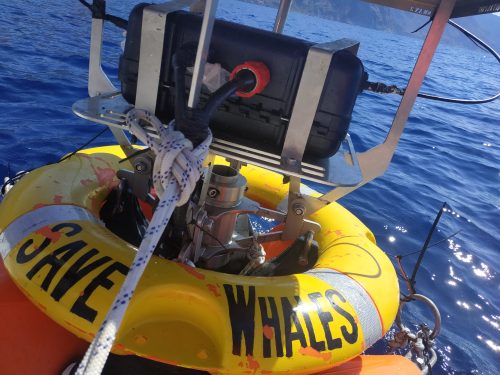
A major step towards the implementation of the SAvE Whales initiative has been achieved with the inclusion of the Green Fund in the project’s partnership. This development was formalized through the signing of an Addendum to the existing Memorandum of Understanding, strengthening the institutional basis and long-term sustainability of the effort to protect sperm whales in the Mediterranean.
The SAvE Whales project (System for the Avoidance of ship-strikes with Endangered Whales) aims to develop an innovative monitoring and early warning system to reduce collisions between vessels and large marine mammals, with a particular focus on sperm whales. The system will be deployed in a highly sensitive marine area between Kythira, Cape Tainaro and Cape Malea, where rerouting shipping lanes is not easily feasible. It is expected to be fully operational by 2028, after which it will be handed over to the Natural Environment and Climate Change Agency (NECCA) for its management and operation.
The participation of the Green Fund secures €2.38 million in national public co-financing, complementing the €700,000 contribution from the international environmental organization OceanCare.
The Addendum was signed on March 6, 2026, by the Minister of Environment and Energy Stavros Papastavrou, the President of NECCA Maria Papadopoulou, the President of the Green Fund Ioannis Androulakis, Co-founder and Policy Director of The Green Tank Ioli Christopoulou, Founder and President of OceanCare Sigrid Lüber, and the organization’s Managing Director Fabienne McLellan.
The initiative forms part of Greece’s commitment announced at the Our Ocean Conference 2024. In this context, a Memorandum of Understanding was signed in June 2024 between the Ministry of Environment and Energy, NECCA, OceanCare and The Green Tank. Since then, a Steering Committee has been operating systematically, under the coordination of the Green Tank, targeted field activities were carried out by the project’s scientific partners, the Pelagos Cetacean Research Institute and the Institute of Computational and Applied Mathematics of the Hellenic Institute of Technology and Research (FORTH), alongside ongoing engagement with competent authorities and the shipping community.
Nicolas Entrup, Director of International Relations at OceanCare, noted, “OceanCare supported the first phase of the SAvE Whales project with the necessary funding, seeing an idea become a reality and embraced by institutional bodies in Greece. With the participation of the Green Fund, the project is now fully implemented, significantly strengthening the protection of sperm whales in the Mediterranean. We will continue to support the project until its full implementation.”
Ioli Christopoulou, Policy Director and co-founder of The Green Tank and coordinator of the SAvE Whales Steering Committee, emphasized: “With the collaboration of all partners now established, as reflected in each Steering Committee meeting, we welcome the Green Fund to SAvE Whales. The active participation of another public body is a crucial step in mitigating the main threat to sperm whales: collisions with ships.”
SAvE Whales is based on innovative technology that detects sperm whale vocalizations through underwater hydrophones. The data is transmitted in real time to passing vessels, enabling them to adjust speed or course and thereby avoid dangerous collisions.
Sperm whales—the largest toothed whales on the planet—are under severe threat in the Mediterranean, with the Eastern Mediterranean population estimated at fewer than 200 individuals. Ship strikes are currently the greatest threat to their survival, particularly in the Hellenic Trench, which is considered a high-risk area. The SAvE Whales project is also included as a management measure in the Special Environmental Study for the National Marine Park of the Ionian Islands.
The next phase of the project includes the launch of an international tender for the contractor that will develop the upgraded system, as well as its pilot deployment in combination with new field research and the establishment of the necessary operational measures for full implementation.


