


How can nature-based solutions help restore marine and coastal ecosystems at scale? And what policy changes are needed to turn Europe’s commitments to nature restoration into action?
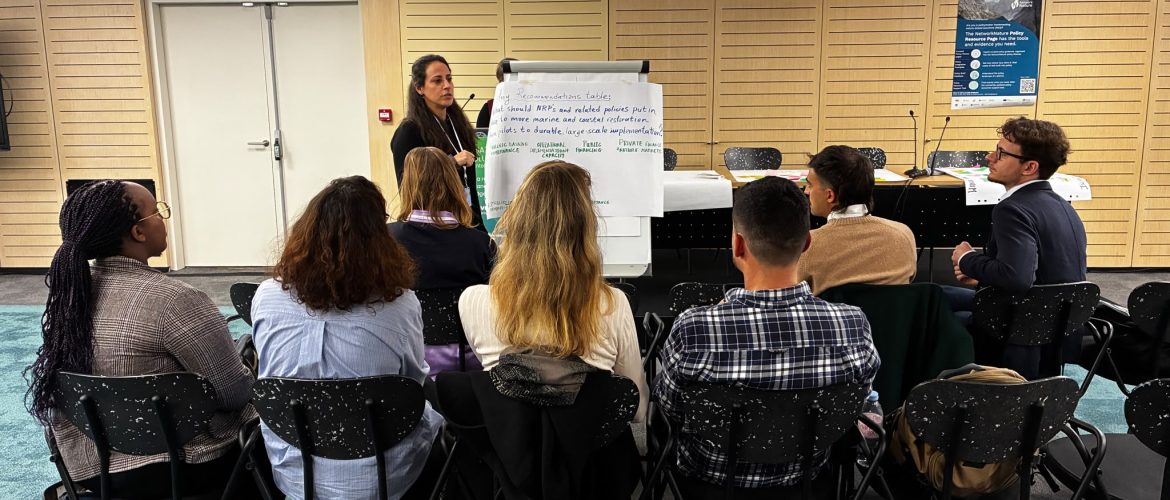
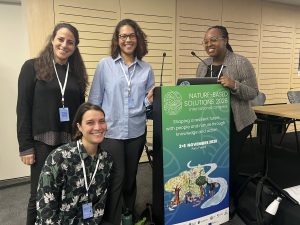
These questions were at the heart of the workshop “Restoring Europe’s Seas: Nature-based Solutions for Marine Restoration”, co-facilitated by Auriane Flottes de Pouzols (IEEP) and Naomie Kayitesi (IUCN) on 2 November 2026 in Paris. The workshop took place as part of the NetworkNature Science–Policy Dialogue, held during the Nature-Based Solutions International Congress 2026.
 Participants split into three thematic groups to explore different aspects of implementing nature-based solutions to restore marine and coastal ecosystems:
- Solutions: Which practical solutions have the greatest potential for implementation? What benefits do they offer, and what conditions are needed to put them into practice? This table was facilitated by Coco Koedooder (VLIZ/DuneFront).
- Barriers: What practical, institutional, financial and other obstacles stand in the way of implementing these solutions? This table was facilitated by Auriane Flottes de Pouzols (IEEP).
- Policy recommendations: What policy changes are needed to support wider implementation and scale-up? This table was facilitated by Dimitra Syrou, Nature Policy Associate at The Green Tank.
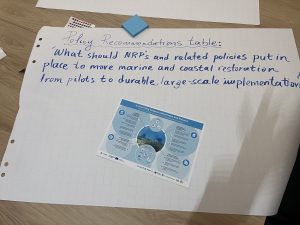 At the Policy Recommendations table, discussions drew on the 15 policy recommendations developed through the Interreg Euro-MED ARTEMIS project, in which The Green Tank was a partner. The recommendations focus on restoring Posidonia oceanica meadows in the Mediterranean and highlight the need to strengthen governance and strategic planning, improve operational implementation and institutional capacity, secure long-term public funding, and develop credible private financing mechanisms for restoration.
Building on these recommendations, participants explored how National Restoration Plans and related policies can help move beyond isolated pilot projects towards coordinated, long-term restoration efforts at scale.
Discussions across the three thematic tables highlighted four interconnected priorities for moving from pilot actions to sustained implementation at scale:
- Integrating nature-based solutions into strategic planning and National Restoration Plans, supported by cross-sectoral coordination and a clear allocation of responsibilities among the relevant authorities.
- Strengthening implementation capacity, through an appropriate institutional and legislative framework, technical tools, accessible data, monitoring systems and stronger capacities among the organisations responsible for implementation.
- Securing stable, long-term funding for ecosystem restoration, monitoring and maintenance, through public resources complemented by private or blended finance mechanisms.
- Ensuring meaningful and inclusive participation by coastal communities and sea users, fostering public acceptance and a fair distribution of costs and benefits.
The discussions underscored the broader contribution that nature-based solutions can make to marine ecosystem restoration, as well as their importance for the effective implementation of the EU Nature Restoration Regulation.


