


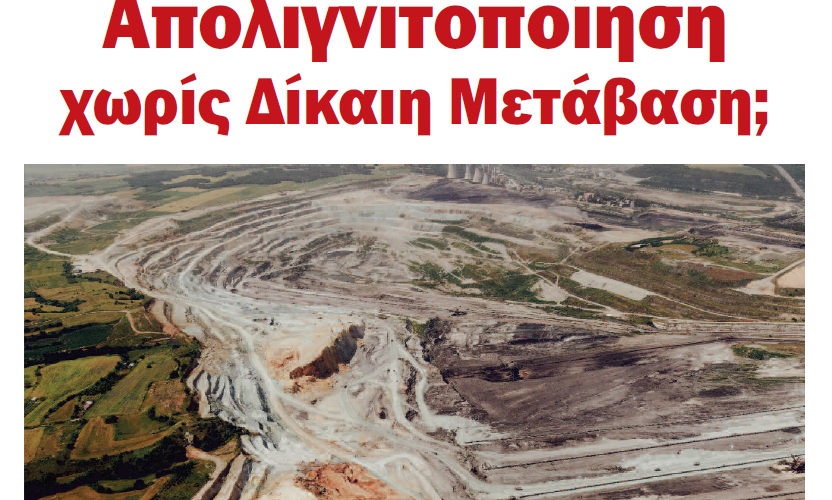
In his article for Oikologiki Enimerosi (Ecological News), Nikos Mantzaris, Policy Lead Analyst and Co-Founder of The Green Tank, examines the progress of Greece’s lignite phase-out and assesses whether it has been accompanied by a truly just and socially responsible transition for lignite-dependent regions.
With the country set to fully exit lignite in 2026, the article highlights the disadvantaged position of these regions in terms of unemployment rates and Gross Value Added, while also pointing out gaps and delays in the implementation of the Just Development Transition plan.
Particular emphasis is placed on the low absorption of available funds, the lack of mine rehabilitation, the misguided choices promoting the use of fossil gas for district heating, and the continued delay in supporting sustainable solutions such as energy communities, the electrification of heating, and renewable energy sources.
Read the full article [in Greek] as published in Issue 242 of Oikologiki Enimerosi (28 January 2026) here.
Full article [in English] below:
Decarbonization Without a Just Transition?
The sharp reduction in lignite activity in recent years has already yielded significant benefits for Greece’s climate performance—benefits that could have been even greater if electricity generation had shifted less toward fossil gas and more toward renewable energy.
According to repeated announcements from PPC, 2026 marks the year Greece will fully phase out lignite. This closes a cycle that began more than 70 years ago, contributing decisively to the country’s economic development. At the same time, however, it has left a heavy footprint on the climate, air quality, and natural resources of the lignite regions of Western Macedonia and Megalopolis. Transitioning to a new productive model and creating jobs to replace those lost from the gradual reduction and eventual cessation of lignite activity represents the largest developmental and social challenge—not only for Greece but for all of Europe, which is following the same path of decarbonization.
More than six years after the Prime Minister’s 2019 announcement of Greece’s exit from lignite, and as we enter the final year of its use in the energy mix, it is now crucial to assess the progress of the transition and, most importantly, its impact on the communities that for decades sacrificed their quality of life to power the country.
Following the announcement at the UN in New York, consultations, legislative initiatives, and administrative interventions led to the creation of the “Just Development Transition” plan and secured significant European and national funding for its implementation. Yet, the gap between the theory of a “Just Transition” and practice remains wide. The local economies of Western Macedonia and Megalopolis are still far from a meaningful shift toward a sustainable development model.
The absorption rate of the Just Development Transition Program (2021–2027) is slow: more than three years after its launch, less than €130 million—about 8% of the program’s total €1.6 billion budget—has been disbursed. Meanwhile, land reclamation in the mines has not even begun, depriving the regions of critical land needed for new economic activities that could create jobs.
Equally concerning is the approach to district heating in Western Macedonia, which relies exclusively on fossil gas. Beyond the negative climate impact, the high cost of gas as a heating source poses serious economic risks for households and businesses in the three municipalities connected to the system. In contrast, the heat pump installation program—a cost-effective and environmentally sustainable alternative—is funded with only €12 million from the Just Transition Fund and, two and a half years after the related call, has still not been implemented. Support for energy communities is similarly limited, despite their potential to reduce energy costs in a region with very high energy poverty. The strong public interest in active participation in the energy transition is reflected in the fact that Western Macedonia ranks second nationwide in the number of energy communities. However, the lack of available grid capacity, the lower performance of the new self-consumption framework (net billing), and insufficient funding have effectively stalled the development of new projects.
It is notable that from the relevant €41.8 million support program, only two municipalities have benefited so far, while no support has been provided to citizen or business energy communities.
Meanwhile, socio-economic indicators remain discouraging. According to ELSTAT, Western Macedonia recorded the highest unemployment rates in the country during two of the first three quarters of 2025. This is not a temporary trend: between 2019 and 2024, the region consistently ranked first nationwide in unemployment rates. Youth unemployment (ages 18–29) remains particularly alarming, standing as the highest among lignite regions in the European Union. In addition, Eurostat data show that Western Macedonia is the only region in Greece whose Gross Value Added, in terms of purchasing power, did not increase in 2023 compared to 2012, when the country as a whole was in deep economic recession.
Consequently, the risk of failure for the “Just Transition” initiative is now clear. Accelerating the implementation of the existing plan is necessary but not sufficient. A reorientation of funding priorities is required toward actions that will have tangible impacts on citizens’ daily lives and improve their quality of life: land reclamation, energy efficiency, renewable energy development to meet electricity needs, and electrification of heating.
As all indications suggest that in the next programming period there will be no separate European Just Transition Fund, it is absolutely critical that the government secures sufficient resources and works closely with local authorities, stakeholders, and civil society to co-create a plan that guarantees a smooth and sustainable transition to the post-lignite era.


