


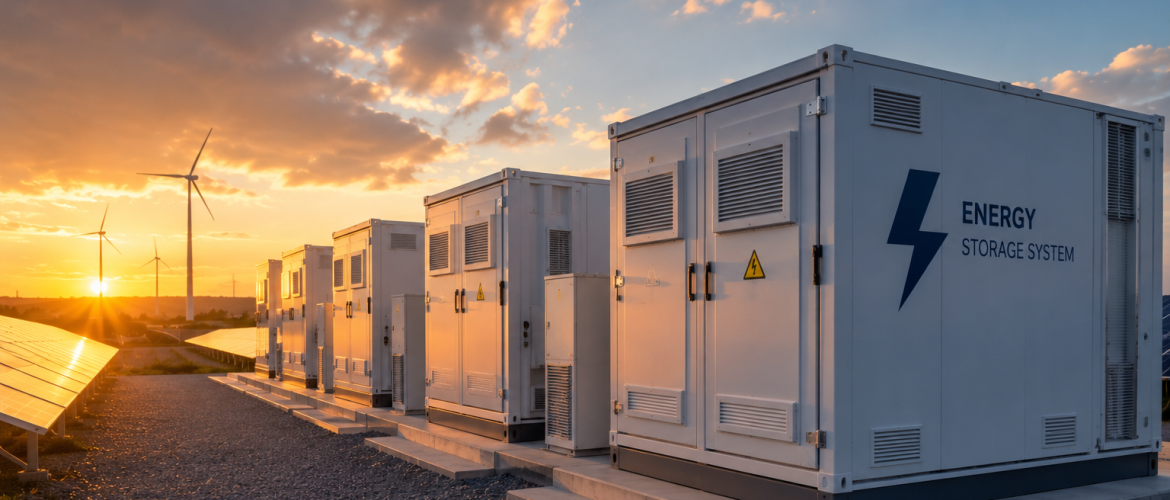
What impact have the first battery storage systems had on Greece’s electricity market? How much renewable energy curtailment have they prevented? To what extent have they reduced fossil fuel use, and how effectively have they capitalised on wholesale electricity price fluctuations?
In a new article for energypress titled “An ‘X-ray’ of the market three months after the launch of operation of the first batteries”, Nikos Mantzaris, Lead Policy Analyst and Co-Founder of The Green Tank, analyses data from the first three months of battery storage operation (April–June 2026) and assesses their contribution to the electricity market.
The analysis shows that, despite the still limited installed capacity (210 MW by the end of June), battery storage systems:
- prevented 2.19% of renewable energy curtailment (26.7 GWh),
- reduced fossil fuel-based electricity generation by 0.5%,
- effectively captured wholesale electricity price fluctuations (by more than 70%), demonstrating that energy arbitrage is working efficiently.
The article also highlights the growing challenge of solar value deflation, as increasing renewable energy curtailment and the rising number of zero or negative price hours are eroding the value of solar generation. As the analysis concludes, expanding battery storage is essential to make better use of renewable electricity, reduce reliance on fossil gas, lower electricity prices, and help achieve Greece’s climate targets.
Read the full analysis below. It was also published on energypress [in Greek] on 14.07.2026 here.
An X-ray of the Electricity Market Three Months After the First Battery Storage Systems Came Online
Solar photovoltaic (PV) systems have been at the forefront of renewable energy deployment in Greece in recent years, reaching 11,538 MW of installed capacity by the end of 2025. According to data compiled by Ember, Greece ranked third among the EU-27 in terms of the share of solar PV in the electricity generation mix in 2025, behind only Hungary and Cyprus.
PV generation has also played a pivotal role in reducing wholesale electricity prices. Given the close relationship between wholesale and retail electricity markets in Greece, these lower wholesale prices have ultimately benefited end consumers.
However, the rapid expansion of PV capacity has increasingly been accompanied by pronounced “cannibalization” effects. The continuous growth in installed PV capacity has coincided with a sharp increase in renewable energy curtailments and in the number of hours with zero or negative wholesale electricity prices (Table 1), thereby reducing generators’ revenues. Both phenomena disproportionately affect solar PV, as curtailments and negative prices occur almost exclusively during periods of high solar irradiation.
Table 1. Renewable energy curtailments and the number of hours with near zero (<€0.05/MWh) or negative wholesale prices during the first half of the year (2024–2026).
| Period | Curtailments (GWh) | Hours with zero/negative prices |
| H1 2024 | 513.5 | 135 |
| H1 2025 | 1,327.1 | 168 |
| H1 2026 | 1,601.4 | 788 |
The declining market value of solar PV is best reflected in its solar capture rate. Analysis of ENTSO-E data for the first half of 2024–2026 shows that the average capture rate fell from 71.9% in 2024 to 61.6% in 2025, before dropping further to just 44.0% in 2026. As illustrated in Figure 1, the decline affected every month of the first half of the year, with the sharpest deterioration occurring in May 2026, when electricity generated by PV systems captured only 28.3% of the average wholesale electricity price.
Figure 1: Solar Capture Rate during the first six months of 2024–2026.
The main reason behind the declining value of solar electricity is the electricity system’s inability to absorb the growing supply of solar generation during midday hours. Battery energy storage systems (BESS) represent the most effective solution both for reducing renewable energy curtailments and for shifting larger volumes of renewable electricity to other hours of the day.
In turn, greater utilization of low-cost renewable electricity can displace expensive and carbon-intensive natural gas generation, producing two important benefits: lower wholesale electricity prices—which ultimately benefit consumers—and a reduction in the carbon intensity of the power sector. This is particularly important given that emissions from electricity generation have deviated significantly from the targets set in Greece’s National Energy and Climate Plan (NECP), largely due to increased gas-fired generation in recent years.
How Much Curtailment Did Batteries Prevent?
Data from ADMIE’s scheduling process show that during the April–June 2026 period, battery storage systems absorbed a total of 30.7 GWh of electricity and subsequently discharged 27.1 GWh back into the grid.
As shown in Figure 2, both charging and discharging volumes increased steadily over time, reflecting the gradual commissioning of additional battery capacity. The highest daily charging and discharging volumes reached 803 MWh and 743 MWh, respectively, both recorded on 28 May.
Regarding their contribution to reducing renewable curtailments, approximately 4 GWh of the electricity absorbed by batteries during the three-month period was charged during hours when no renewable curtailments occurred. Since 1,191.4 GWh of renewable generation was curtailed between April and June (estimate based on ADMIE’s data), batteries prevented approximately 26.7 GWh, corresponding to 2.19% of total renewable energy curtailments.
At the same time, the 27.1 GWh discharged by batteries displaced approximately 0.5% of fossil-fuel electricity generation during the same period.
Figure 2: Daily battery charging (total and during hours without renewables curtailment) and discharging volumes during April–June 2026.
The highest charging power recorded during the period was 207.5 MW, while the maximum discharging power reached 201 MW. Both values are very close to the corresponding capacities reported in ADMIE’s latest available registry of connected Battery Energy Storage Systems (April 2026), namely 210 MW of charging capacity and 201.3 MW of discharging capacity across nine battery installations. It should be noted, however, that on the final day of the period (30 June), an additional battery system entered commercial operation, reaching an instantaneous charging rate of 70 MW before later discharging an equivalent amount of electricity.
How Efficient Was Arbitrage?
By combining 15-minute battery charging and discharging data with wholesale electricity prices from the Hellenic Energy Exchange (HEnEx), daily charging costs, discharging revenues, and the corresponding energy-weighted capture prices for charging and discharging were calculated for each day of the three-month period.
Over the quarter, the total cost of purchasing electricity for battery charging amounted to approximately €539 thousand, while revenues from selling the discharged electricity reached €4.2 million.
As shown in Figure 3, the median charging price was just €5.29/MWh. Moreover, on 26 out of 91 days, batteries charged during periods of negative electricity prices, effectively earning revenue while charging rather than incurring costs.
The two highest charging prices recorded during the quarter were €131.6/MWh and €122.2/MWh, occurring on the first two days of battery operation (1–2 April).
Conversely, the selling price of discharged electricity ranged between €103.1/MWh (25 May) and €308.6/MWh (30 June), with a median value of €147.8/MWh.
Figure 3: Distribution of daily battery charging and discharging capture prices, alongside Day-Ahead Market (DAM) daily prices during April–June 2026.
Finally, Figure 4 shows that battery energy trading closely tracked wholesale market price fluctuations. On average during the three-month period, the daily spread between battery discharging and charging prices exceeded 70% of the corresponding daily spread between the maximum and minimum DAM prices, demonstrating that batteries captured a substantial share of the available wholesale price volatility.
Figure 4: Daily spread between energy-weighted battery discharging and charging prices, compared with the daily DAM spreads during April–June 2026.
Conclusions
The evidence suggests that during their first three months of operation, battery storage systems already established a modest—but steadily growing—presence in the Greek electricity market. They prevented 2.19% of renewable energy curtailments and reduced fossil-fuel electricity generation by 0.5%.
From an economic perspective, arbitrage proved effective as batteries captured approximately 70% of the available wholesale price spread, resulting in positive financial returns.
The most significant benefits for electricity consumers, however, will become evident only once installed battery capacity reaches levels substantially higher than the 210 MW that had entered operation by the end of June.


