


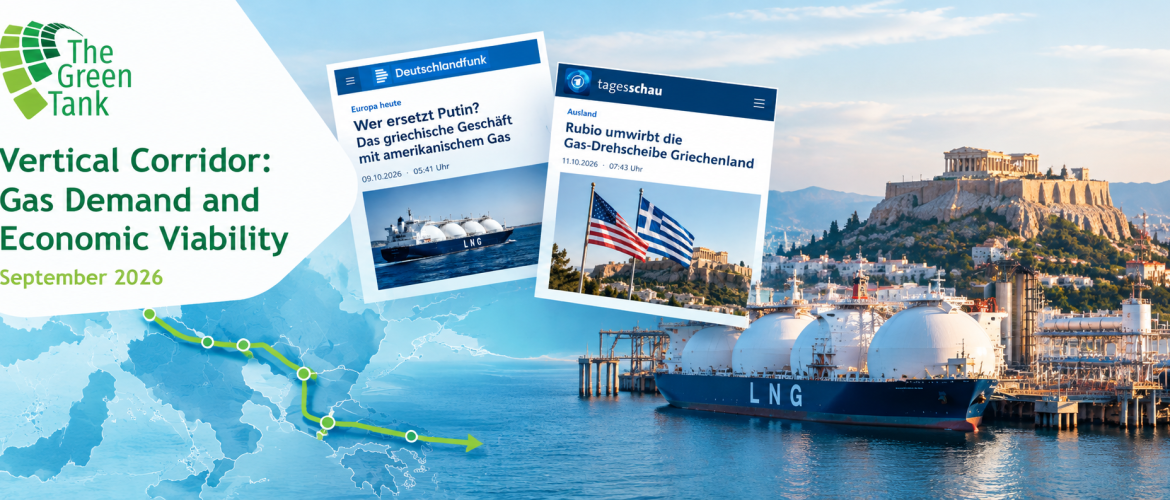
Europe aims to end all Russian gas imports by November 2027. Greece aspires to play a central role in this effort, becoming a gateway for US liquefied natural gas (LNG) to Southeastern and Central Europe through the Vertical Corridor. But how much of this new infrastructure is actually needed, and what will it cost consumers?
These questions were explored in two German media reports by Jasper Riemann featuring Nikos Mantzaris, Policy Analyst Lead and co-founder of The Green Tank.
On 9 October, German radio Deutschlandfunk published “Wer ersetzt Putin? Das griechische Geschäft mit amerikanischem Gas [Who Will Replace Putin? Greece’s Energy Deal with the US]”, examining the tension between Europe’s pursuit of energy security and the risk of replacing one dependency with another.
On 11 October, Tagesschau published online “Rubio umwirbt die Gas-Drehscheibe Griechenland [Talks in Athens: Rubio courts Greece as a gas hub]”, questioning the need for the proposed infrastructure.
Nikos Mantzaris described the Vertical Corridor as “oversized and expensive”, pointing out that even if all demand arising from the loss of Russian gas across the Vertical Corridor countries were met exclusively through Greek LNG terminals, and the phase-out of gas proceeded slowly, only one of the four new terminals currently planned would be needed.
He also criticised the lack of a clear strategy, warning that the investments could ultimately work against the public interest and consumers, while being difficult to reconcile with the EU’s climate targets.
Read The Green Tank’s analysis of the Vertical Corridor here.
Read the translation of the Tagesschau report below:
Talks in Athens: Rubio courts Greece as a gas hub
Southeastern European countries are building a pipeline network designed to distribute gas across the continent as they seek to become independent of Russia. The United States, a major exporter of liquefied natural gas, is also showing interest. Is Europe at risk of becoming dependent on another supplier?
By Jasper Riemann, ARD Athens
During his visit to Athens, US Secretary of State Marco Rubio discussed a range of issues, including mass migration, terrorism and defence. Standing in front of the Acropolis, he also invoked the roots of Western civilisation. But for Ino Afentouli, a foreign policy expert at the Athens-based think tank Eliamep, one issue stood out above all others. “I believe the visit confirmed the US administration’s particular interest in the energy sector. The question is how the United States intends to expand the transportation and distribution of its own liquefied natural gas to Europe through the so-called Vertical Corridor.”
The Vertical Corridor is a network of pipelines intended to transport gas from Greece through Bulgaria and Romania to Ukraine, among other destinations. The EU aims to end all Russian gas imports by November 2027 at the latest.
The prospect of Russian gas disappearing from the European market has fuelled a wave of activity involving gas companies, shipping firms and politicians across Southeastern Europe. Critics warn that this could lead to the construction of new fossil fuel infrastructure that may not even be needed.
Greek Prime Minister Kyriakos Mitsotakis, however, emphasises that Greece has become a “central player in Southeastern Europe”, having previously stood “on the margins of the energy system”.
The Vertical Corridor is intended to turn Greece into a major entry point for liquefied natural gas (LNG), particularly from the United States. Greece already has two LNG terminals, with four more announced or in the planning stages, although it remains unclear which of them will actually be built.
New gas exploration projects involving US companies
The momentum is being driven by a US energy offensive in the region. For the first time in decades, Greece is preparing to resume gas exploration drilling off its western coast. US oil major ExxonMobil is involved, while another American oil company, Chevron, is participating in planned drilling projects, including areas south of Crete.
Kimberly Guilfoyle, the US ambassador to Greece, has toured the region in recent months, promoting deals with American companies. The United States has a strong interest in investing in Greece, she said.
Energy expert Michalis Mathioulakis, also of Eliamep, explains that the initiative goes well beyond a single pipeline. “This is an entire pipeline system, and much of what is currently being built consists primarily of upgrades, new pipeline sections and interconnectors between countries.”
Mathioulakis describes the situation as a win-win. European and US interests currently align in this area. He also argues that natural gas will remain necessary for a long time because the energy transition has not progressed far enough. Europe, he says, needs energy security.
Is the project oversized?
Nikos Mantzaris, lead analyst at the Greek think tank The Green Tank, takes a different view of the Vertical Corridor, describing it as “oversized and expensive”.
That is also the central message of an analysis published by The Green Tank at the end of September.
“Even if all the demand arising from the loss of Russian gas across every country along the Vertical Corridor were met exclusively through LNG terminals in Greece, only one of the four terminals currently planned would need to be built.”
Mantzaris expects gas demand to decline over the long term and also points to the high cost of LNG. He criticises the Greek government’s plans as lacking transparency and clarity.
He says a clear strategy is missing.
“They are simply improvising — not just the Greeks, but all the parties involved. That makes it dangerous. It will ultimately backfire on the public interest and consumers as a whole, not just in Greece but everywhere.”
He also argues that the investments are difficult to reconcile with the EU’s climate targets.
US market power
Ana Maria Jaller-Makarewicz of the Institute for Energy Economics and Financial Analysis (IEEFA) argues that investment should go towards electrification rather than the Vertical Corridor, for example by better integrating electricity grids across the region. That, she says, is where the future lies.
She also highlights another concern. In August and September, around 70% of all LNG imported into the EU came from the United States. The fear is that, instead of diversifying its supplies, the EU could simply be shifting from one dependency — on Russia — to another, this time on the United States.
Decision-makers in the Greek government, at least, do not see close cooperation with the United States as a problem. On the contrary, while Rubio described the alliance with Greece as historic during his visit to Athens, his Greek counterpart, Giorgos Gerapetritis, said the Greek-American partnership had never been stronger, deeper or more united.
————————————————————–
Read the translation of the radio transcript on Deutschlandfunk below:
Who Will Replace Putin? Greece’s Energy Deal with the US
Europe is seeking to strengthen its defences against Russia, and not just militarily. The European Union also wants to end its dependence on Moscow for energy once and for all.
Russian gas imports are due to be phased out completely by November next year. Greece could play a key role in this process. Under a new energy corridor, US liquefied natural gas (LNG) could be transported from Greece all the way to Ukraine.
US Secretary of State Marco Rubio discussed the project with the Greek government during his visit to Athens this week. But it also raises questions about Europe’s strategic autonomy. Will dependence on Russia simply be replaced by a new dependence on the United States? Jasper Riemann reports on a project caught between geopolitical interests and climate concerns.
During his visit to Athens, US Secretary of State Marco Rubio discussed a range of issues, including mass migration, terrorism and defence. Standing before the Acropolis, Rubio invoked the roots of Western civilisation.
But for Ino Aventouli, a foreign policy expert at the Athens-based think tank ELIAMEP, energy was the main focus. “I believe the visit confirmed the US administration’s interest, particularly in the energy sector. The question is how the United States intends to expand the transportation and distribution of its own LNG to Europe via the so-called Vertical Corridor.”
The Vertical Corridor is a network of pipelines designed to transport gas from Greece through Bulgaria and Romania to Ukraine, for example. The EU aims to end all Russian gas imports by November 2027 at the latest.
The prospect of Russian gas supplies disappearing has accelerated a trend that is now gathering momentum among gas companies, shipping businesses and politicians across south-eastern Europe.
“Looking at the gas sector, we have managed to turn a country that was previously on the margins of the energy system into a key player in south-eastern Europe,” Greek Prime Minister Kyriakos Mitsotakis said in March.
The Vertical Corridor is intended to turn Greece into a major entry point for LNG, particularly from the United States. Greece already has two LNG terminals, with four more announced or in the planning stages, although it remains unclear which of these will actually be built.
The Vertical Corridor is not simply a single pipeline, explains energy expert Michaelis Mathioulakis of the ELIAMEP think tank. “It is an entire system of pipelines. Much of what is currently being built consists primarily of upgrades, new pipeline sections and interconnectors between countries.”
Mathioulakis describes the project as a win-win situation.
European and American interests are currently aligned on this issue. He also argues that natural gas will remain necessary for a long time, as the energy transition has not progressed far enough. Europe needs energy security.
Nikos Mantzaris, lead analyst at the Greek think tank The Green Tank, takes a different view of the Vertical Corridor. “Overdimensioned and expensive” is the central message of an analysis published by The Green Tank at the end of September.
Even if all the demand arising from the loss of Russian gas across every country along the Vertical Corridor were met exclusively through LNG terminals in Greece, only one additional LNG terminal would be needed out of the four currently planned.
Mantzaris expects gas demand to decline over the longer term and also points to the high cost of LNG. He further argues that investment in the Vertical Corridor is difficult to reconcile with the EU’s climate goals.
Other critics fear that the EU is simply shifting from one dependency to another: away from Russia and towards the United States.
In Greece, at least, decision-makers do not see close cooperation with the US as a problem. On the contrary, while US Secretary of State Rubio spoke in Athens of a historic alliance with Greece, his Greek counterpart, Giorgos Gerapetritis, said that the Greek-American partnership had never been stronger, deeper or more united.


