


Renewables and Large Hydropower Drive Electricity Prices Down
In February 2026, increased electricity production from wind and hydropower displaced significant amounts of fossil fuels. Compared to February 2025, renewable energy sources (wind and solar) grew by 20% (+300 GWh), while large hydropower plants produced five times more (+874 GWh). The combined increase of 1,174 GWh of clean energy led to a nearly equivalent reduction in fossil fuel use: fossil gas fell by 35% (-838 GWh) and lignite by 47% (-205 GWh).

The Green Tank participates in the ARTEMIS partners meeting in Sardinia
Two important and inspiring days for the ARTEMIS Interreg Euro-MED Natural Heritage project took place on 3–4 March 2026 in Santa Teresa Gallura, Sardinia, where partners met at the project’s Sardinian pilot site, the Capo Testa – Punta Falcone Marine Protected Area.

Joint letter by environmental organisations to the Board of Directors of the European Investment Bank (EIB) on the ETS2 Frontloading Facility
Efforts to weaken the new Emissions Trading System for buildings and road transport (ETS2)—culminating in a one-year delay to its start—make parallel measures essential to ensure its fair and socially sustainable implementation. In this context, the European Commission—following interventions by civil society—has promoted the creation of an ETS2 Frontloading Facility through the European Investment Bank (EIB). This frontloading mechanism will allow Member States to gain early access to future revenues from the auctioning of emission allowances under ETS2 for buildings and road transport.

Greece lagging behind Europe and national e-mobility targets
Greece is far behind the European Union average in the adoption of electric mobility. According to ACEA data, the share of new battery electric vehicles (BEVs) in the EU-27 (17.4%) was nearly three times higher than in Greece (6.17%), while the share of plug-in hybrid vehicles (PHEVs) reached 9.4%, again exceeding the corresponding Greek figure (8.08%). For the first time, the combined share of these two low-emission vehicle categories in the EU-27 (26.8%) surpassed that of conventional petrol vehicles (26.6%).

The Green Tank Supports Energy Upgrades of Municipal Buildings in the North and South Aegean and Tourism Development in Western Macedonia
The Green Tank voted in favor during the tenth written evaluation process conducted by the Hellenic Managing Authority (EYDAM) under the 2021–2027 Just Transition Development Program (JTDP). The submitted dossier included two projects. The first project concerns energy upgrade works for public and municipal buildings in the North and South Aegean regions, with a total budget of €10 million (€6.854 million for the North Aegean and €3.154 million for the South Aegean).
State of Climate in Greece 2025: The Electricity Generation Sector
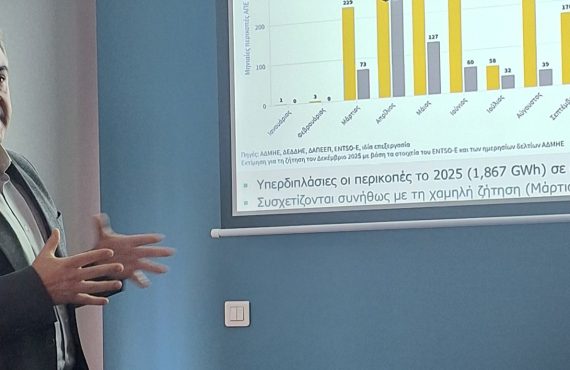
As part of the State of Climate in Greece for 2025, conducted by scientists from the Institute for Environmental Research and Sustainable Development at the National Observatory of Athens and organized by the Climatebook information hub, Nikos Mantzaris presented the results of the Green Tank analysis for the electricity generation sector.

Scientific publication on the governance of protected areas in Greece
A new scientific study examines the reasons why Greece’s system of protected areas continues to face serious challenges, despite repeated institutional reforms and improved administrative coordination in recent years.

Just Transition Newsletter #10
The tenth issue of The Green Tank’s newsletter has been published, covering developments over the past six months related to the Just Transition of lignite regions in Greece and across Europe (July–December 2025).

Stagnation in self-production and energy communities after the transition to net billing
1,747 energy communities, but only 18 new project applications in 6 months. Central Macedonia is the “champion” in electrified capacity, while in Western Macedonia for every 1 MW electrified, 3.6 MW are cancelled. The 1 GW “barrier” in self-generation was broken, however, from the ministerial decision on net billing (October 2024) to September 2025, only 16.5 MW of projects implementing the new mechanisms, were connected.
Why does Greece’s electricity market remain so expensive?
Despite the increase in electricity generation from Renewable Energy Sources (RES), Greece consistently remains among the most expensive countries in Europe in the day-ahead electricity market (DAM). According to a new analysis by The Green Tank, which also compares Greece with Portugal, the main reasons are the country’s growing dependence on fossil gas and the lack of energy storage infrastructure.

Transforming Marine Science into Action: Side event at the 24th COP of the Barcelona Convention
On the occasion of the 24th Meeting of the Contracting Parties to the Barcelona Convention (COP24), The Green Tank co-organized and moderated a side event titled “From Science to Action: Strengthening Conservation and Cooperation for Priority Mediterranean Species and Habitats” that was held on 4 December 2025 at the St. Regis in Cairo, Egypt. The event brought together leading scientific initiatives, regional institutions, and policy actors working to advance marine conservation across the Mediterranean.

Greece falls to 30th place in 2026 Climate Change Performance Index: Renewable Energy Progress Amid Climate Policy Challenges
Greece is ranked 30th in this year’s Climate Change Performance Index (#CCPI) 2026, among 63 countries, marking an 8-place drop compared to 2025. According to the ranking published today at COP30 in Brazil, Greece remains a medium performer in greenhouse gas emissions, renewable energy, and energy use, while climate policy is once again rated as low.
Is the EU-27 backtracking on its climate policy?
Despite being the only region to cut emissions in 2023–2024, proposed changes to the EU #ETS2 risk increasing emissions and reducing revenues needed for the green transition. Environmental NGOs and think tanks — including The Green Tank — sent a letter to Commissioner Hoekstra.

Revision of ETS2: an opportunity or a setback for the European Green Deal?
In a letter addressed to 19 Environment Ministers, Climate, Net Zero and Clean Growth Commissioner Wopke Hoekstra announced on 21 October 2025 the European Commission’s intention to amend the rules governing the Market Stability Reserve (MSR). The 19 Ministers had co-signed a joint non-paper in June on price uncertainties in the new Emissions Trading System for buildings and road transport (ETS2).


