


The carbon footprint of electricity production – January 2026
In January 2026, emissions from the power generation sector amounted to 1.68 million tons, down 5.5% compared to January 2025 due to reduced emissions from lignite plants, but the highest in the last 6 months. Emissions from gas plants exceeded last year's (0.9 million tons, 53.6% of the total). The carbon intensity was 265.6 g CO2/kWh, an improvement compared to December but higher than the average carbon intensity for 2025 (264.2 g CO2/kWh).
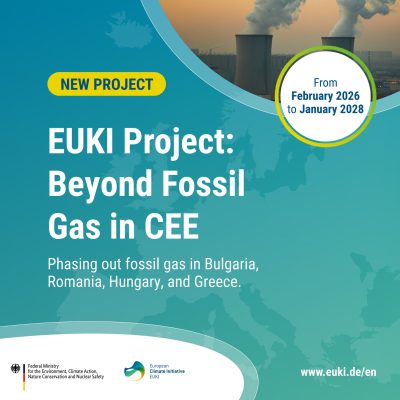
The Green Tank joins new project on fossil gas phase-out
The Green Tank is participating in the new EUKI-funded project “Beyond Fossil Gas in CEE”, a regional initiative aiming to accelerate the phase-out of fossil gas and support a secure and climate-neutral energy transition in Central and Eastern Europe.

Trends in electricity production – January 2026
Record monthly net exports of 1,264 GWh in January 2026. Unlike in 2025, when the increase in exports was linked to increased use of fossil gas, the surge in exports in January is related to the large increase in wind power production, which reached a five-year high of 1,509 GWh. A four-year high was also recorded for large hydroelectric plants with 738.4 GWh. However, the average price on the wholesale electricity market remained at the same level as in December 2025 (€108.7/MWh), due to the extensive use of expensive fossil gas (2,405 GWh), whose production was very close to that

Climate, Wind Energy and Policy Choices
At the event organised by the Hellenic Wind Energy Association (ELETAEN) during the 8th Verde.tec on Saturday, 28 February 2026, Nikos Mantzaris, Head of Policy Analysis and Co-founder of The Green Tank, presented the latest data on the trajectory of Greece’s energy and climate policy.

Energy-Efficient Buildings in the EU: EPBD 2024, National Renovation Plans and Greece’s Transition Challenges
In her article published in Ergoliptikon Vima titled “Energy and buildings: The new landscape of efficiency and sustainability”, Εnergy policy analyst Ioanna Souka highlights the pivotal role of buildings in the energy transition and the new landscape taking shape at both European and national level.
The Green Tank on 102FM: Greece Tops EU Rankings on Energy Poverty, Highlighting the Need for Long-Term Solutions
Ioanna Souka, Energy Policy Analyst at The Green Tank, spoke on Greece’s troubling lead in Eurostat energy poverty indicators and the forthcoming Social Climate Plan in a radio interview on the programme “O men kai i de”, hosted by Maria Tsakiri and Christos Tsalikidis on 102FM.

Trends in fossil gas consumption & imports – January 2026
A record high in domestic fossil gas consumption was recorded in the first month of the year (8.1 TWh). Most of the imports were LNG (5.36 TWh), which also hit a record high, while Russian gas imports (2.13 TWh) were above the average for the last three years. Electricity accounted for the largest share of consumption (61.9%), while gas networks recorded the largest increase (+15.8% compared to January 2025), reaching 2.3 TWh. Compared to EU-27 Member States, Greece had the 8th highest increase in consumption between 2025 and 2024.

Joint letter by environmental organisations to the Board of Directors of the European Investment Bank (EIB) on the ETS2 Frontloading Facility
Efforts to weaken the new Emissions Trading System for buildings and road transport (ETS2)—culminating in a one-year delay to its start—make parallel measures essential to ensure its fair and socially sustainable implementation. In this context, the European Commission—following interventions by civil society—has promoted the creation of an ETS2 Frontloading Facility through the European Investment Bank (EIB). This frontloading mechanism will allow Member States to gain early access to future revenues from the auctioning of emission allowances under ETS2 for buildings and road transport.

Greece lagging behind Europe and national e-mobility targets
Greece is far behind the European Union average in the adoption of electric mobility. According to ACEA data, the share of new battery electric vehicles (BEVs) in the EU-27 (17.4%) was nearly three times higher than in Greece (6.17%), while the share of plug-in hybrid vehicles (PHEVs) reached 9.4%, again exceeding the corresponding Greek figure (8.08%). For the first time, the combined share of these two low-emission vehicle categories in the EU-27 (26.8%) surpassed that of conventional petrol vehicles (26.6%).

Supporting Unnecessary Gas Plants Burdens Consumers
In an article for energypress, Ioanna Souka, Energy Policy Analyst at The Green Tank, emphasizes that supporting unnecessary gas plants comes at a cost to consumers. The recent ENTSO-E power adequacy study (ERAA 2025) shows that a large portion of gas plants in Greece (3.6–4.1 GW out of a total 7.9 GW) is expected to face economic viability challenges. Any new investment in gas-fired units beyond those included in the National Energy and Climate Plan (NECP) entails high investment risk and ultimately increases costs for consumers.
The carbon footprint of electricity production – December 2025
In 2025, emissions from the ever-polluting lignite plants fell to a historic low (3.68 million tons), while those from gas plants reached a historic high of 8.8 million tons. As a result, total emissions from the power generation sector remained at the same level as in 2024, reaching 15.75 million tons, which is 5.55 million tons above the target set in the NECP for the same year (10.2 million tons). Despite the stagnation in total emissions, the sector's carbon intensity fell to a new low (264.7 g CO2/kWh), due to the increase in the country's total electricity production, part of

Decarbonization Without a Just Transition?
In his article for Oikologiki Enimerosi (Ecologica News), Nikos Mantzaris, Policy Lead Analyst and Co-Founder of The Green Tank, examines the progress of Greece’s lignite phase-out and assesses whether it has been accompanied by a truly just and socially responsible transition for lignite-dependent regions.
Trends in electricity production – December 2025
In 2025, renewables (mainly wind & solar) set a production record, covering 46.7% of electricity demand, despite high curtailments (1,867 GWh), while lignite recorded a historic low (2,723 GWh). At the same time, production from fossil gas reached a historic high (23.3 TWh), which was partly channeled into electricity exports, which also reached a historic high (3 TWh). On the other hand, domestic demand was down compared to 2024, reaching 56.5 TWh.
High dependence on expensive fossil gas and the partial utilization of cheap RES resulted in the average price on the wholesale electricity market in 2025 reaching 104.1 €/MWh, an
The Green Tank’s Contribution to the European Commission on Greece’s EU Semester Report
The Green Tank, together with other environmental NGOs, was invited by the European Commission to provide input for the upcoming EU Semester report and recommendations for Greece. Our submission highlighted key gaps in the country’s energy policy and proposed concrete actions to ensure a fair, sustainable, and citizen-focused energy transition.


