


- Self-production projects are not only implemented by energy communities, but also by individual households, farmers, businesses, municipalities and other actors.
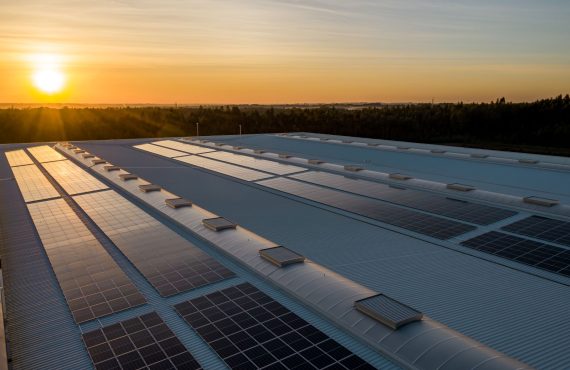
- The electrified capacity of self-production projects by all actors as of April 2026 was 1,155.5 MW (38,086 projects).
- Most of the electrified projects (38,060 projects, 1,083.6 MW) use photovoltaic systems.
Self-production is slowing down: after the “leap” of 2023 where 21,349 new applications were submitted, in 2024 these were limited to 14,019, in 2025 they decreased even further to 5,776, while in the first four months of 2026 only 1,033 new applications were submitted.
The new mechanisms of net billing virtual net billing are problematic: Only 118.1 MW is the electrified capacity of self-production projects applying these mechanisms (10.2% of the total), while only 21.8 MW of these concern applications made after the implementation of the Joint Ministerial Decision of October 2024.
The electrified self-production capacity (1,155.5 MW) so far exceeds that of cancelled self-production projects (826.2 MW).
The capacity of pending projects has decreased to 731.6 MW. Of these, projects with a capacity of 424.2 MW have not yet received a notification of inability to connect – so they have better prospects of being connected – while the capacity of the projects that have already received it is smaller (307.3 MW).
Available electrical space
- The sum of electrified capacity and the capacity of pending self-production projects reached 1,887 MW, approaching the 2 GW of electrical space dedicated for self-production projects by Law No. 5037/2023. In order to enhance the progress of self-production, it is proposed to increase the reserved electrical space for this type of projects to 3 GW.
Our news

1,747 energy communities, but only 18 new project applications in 6 months. Central Macedonia is the “champion” in

Ioanna Theodosiou participated in the dialogue on the future of Western Macedonia, titled ‘Social Cohesion and Transition –

Ioanna Theodosiou participated at the event organized by Greenpeace ‘Energy transition in Magnesia: The climate crisis, fossil gas

The February issue of Shedia street magazine includes a feature on energy communities. The article, by Dimitris Kyriakopoulos, explains

The Green Tank’s eighth newsletter for the developments of the last six months (July - December 2024) related

Ioanna Theodosiou participated in the workshop entitled "The environmental, health and economic impacts of fossil gas expansion in
Ioanna Souka spoke to NaftemporikiTV on 14 November 2024 about the progress of self-production - with 665 MW

Ioanna Theodosiou, policy associate at Green Tank, attended the first National Conference of the Greek Energy Communities Coalition,
PRESS RELEASE Despite the uncertainty which ensued the introduction of net billing, in the first seven months of 2024

The Green Tank's data analyst, Ioanna Souka, moderated a panel titled "Self-consumption and Energy Community Projects" at Solarplaza
The number of energy communities in Greece that are set up purely for self-production of electricity is constantly
The Green Tank approved the amendment to the financing program for energy communities, first published in September 2023.
The Green Tank’s seventh newsletter for the developments of the last six months (January – July 2024) related
The EU Emissions Trading System (EU ETS) is the European Union’s flagship for the reduction of greenhouse gas
In an article for Romanian portal ΙnfoClima, Ioanna Theodosiou – The Green Tank’s policy associate - examines the
The need for energy communities - both in Greece in general and in Western Macedonia in particular -
By June 2024, EU Member States are expected to submit their final revised National Energy and Climate Plans
Despite the strong growth and demand for rooftop PV, EU Member States are lagging behind, according to the
Delving into the crucial realm of fostering a just transition within Greece's lignite regions, Nikos Mantzaris shares insights
Drawing on recent joint analyses by The Green Tank on energy communities, Stelios Psomas and Nikos Mantzaris explain

Ioanna Theodosiou, The Green Tank's policy associate, participated in the first open panel discussion of the "What will KOSMOS
P R E S S R E L E A S E In 2023, self-production by households, farmers, businesses,
The energy transition in Greece is in full swing and experts, scientists and citizens map the most important
At the initiative of Electra Energy Cooperative and EKPOIZO, 16 Energy Communities and Civil Society Organizations, including The
Following the workshop "Community energy law in Greece, Serbia, Poland, and Bulgaria. Stock taking and bottlenecks" which was

The sixth newsletter of the Green Tank for the developments of the last six months (July – December
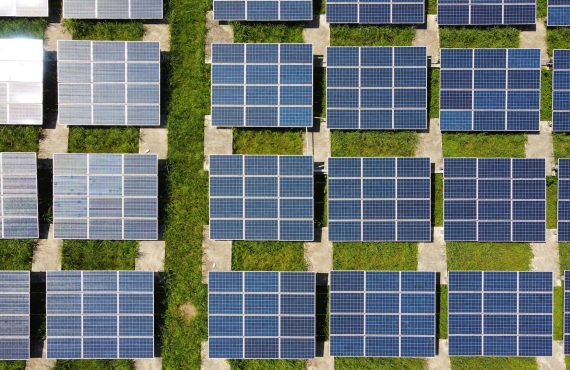
Since 2018, energy communities have taken a central role in the Greece's energy transition as a tool to
In her article entitled “The paradox of Western Macedonia: Energy transition in a bottleneck”, Alexia Kalaitzi, journalist for
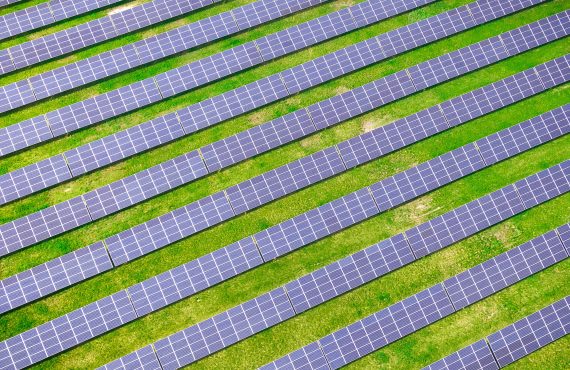
Nikos Mantzaris participated in the Energy Community Forum co-organized by the University of Western Macedonia, the Regional Association

Drawing on data from The Green Tank's new review on energy communities in Greece and its lignite areas,
Increase in self-produced energy hindered by lack of grid space and delays in resources mobilization
P R E S S R E L E A S E Almost twice as many self-production projects
With the question “whether Athens can achieve energy autonomy”, Elvira Krithari, journalist for the Greek newspaper Kathimerini, talked
Stressing that the youth of Kozani and all of Greece’s the lignite regions of the country should be
Ιn view of the October 2023 local elections, The Green Tank sent an open letter to all candidates
P R E S S R E L E A S E In recent years, self-production through energy communities
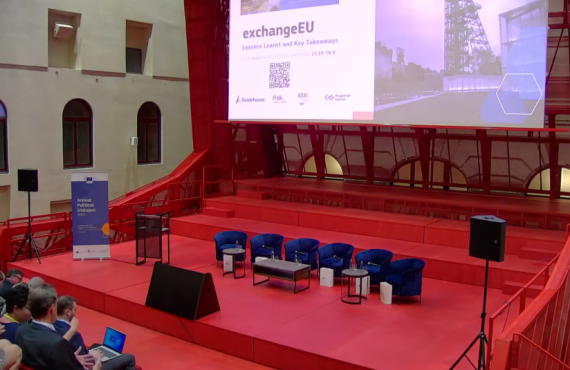
Ioanna Theodosiou participated in the fourth Annual Political Dialogue of the EU Initiative for Coal Regions in Transition,

As energy communities become a vital tool for citizen participation in the energy transition, both in Europe and
In the midst of the energy crisis, energy communities and citizen participation in the use of energy resources
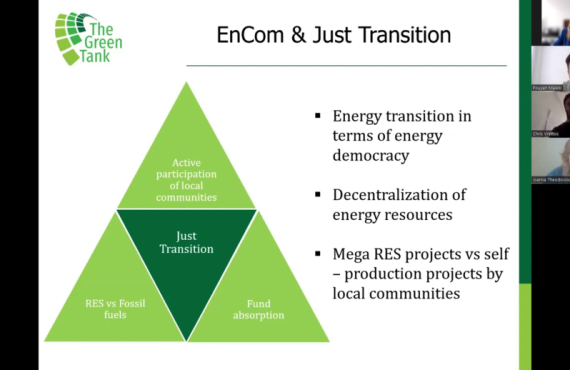
In her contribution to the webinar “Navigating the just transition: role of energy communities”, organized by CEE Bankwatch,
Under a policy measure introduced in 2018, part of the public revenues of greenhouse gas (GHG) emission allowances
Five years of Energy Communities in Greece and The Green Tank launches its Community Energy Watch. Citizens can produce
The Green Tank contributed with comments to the public consultation on the draft bill of the Ministry of
Bringing into the spotlight the role of Municipalities in creating energy communities and ensuring the energy autonomy of
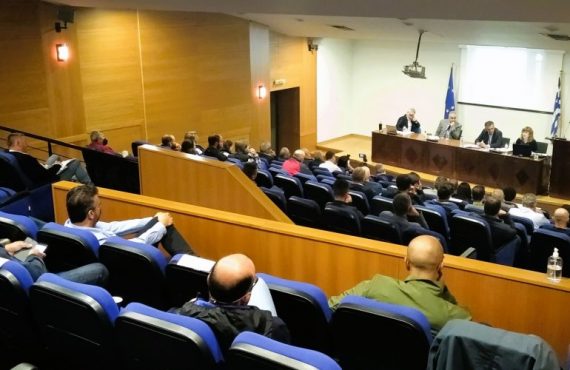
In the city of Kozani, in Western Macedonia, the heart of Greece’s energy transition, local authorities, entrepreneurs, members
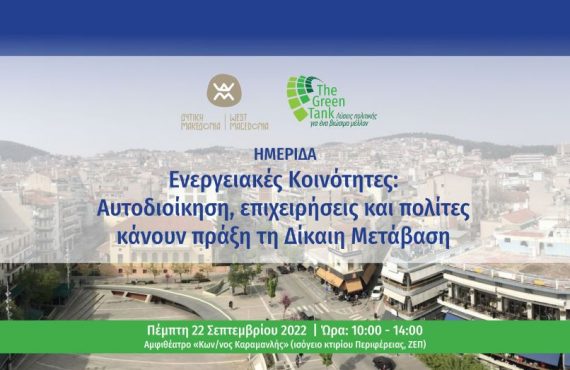
The Region of Western Macedonia and The Green Tank co-organize the workshop “Energy Communities: Local authorities, enterprises and
When reducing energy costs becomes an imperative, local communities turn increasingly to renewable energy sources to meet their
Ioanna Theodosiou, policy officer at The Green Tank, participated in the conference “Rethink! Ideas Forum”, in the session
Τhe Green Tank co-organized a special session on “Community Energy and Just Transition in coal regions” in the
Ioanna Theodosiou, policy officer at The Green Tank, contributed to OIKOTOPIA’s special digital issue on energy with the
An article by Ioanna Theodosiou presenting recommendations for the improvement of the development framework for energy communities in
An article by Ioanna Theodosiou presenting the possibility of laying down a state aid scheme specifically for energy
Ioanna Theodosiou participated in a session of the Just Transition Platform, organized by the European Commission, dedicated on
Comment by Ioanna Theodosiou on the recent developments concerning the development of energy communities in an article by
Nikos Mantzaris participated in the event "Scaling up energy communities in Bulgaria", on October 21, 2021. The event
Ioanna Theodosiou presents recommendations to support the deployment of Energy Communities in order to ovecome existing problems, in
Ioanna Theodosiou participated in the event titled “ Non- profit energy communities: Their role in energy democracy and
Opinion piece by Ioanna Theodosiou about the new reality Renewable Energy Communities need to confront. The upcoming transposition
Opinion piece by Ioanna Theodosiou about the role of the Renewable Energy Communities in the Territorial Just Transition
The Green Tank in collaboration with the Heinrich Boll Stiftung Greece are publishing a feature on the contemporary
Opinion piece by Ioanna Theodosiou on energy communities and the role they should and must play in the


